Which Sunscreen Is Safe for Babies and Children, and How Should It Be Used?
A safe sunscreen for babies and children is usually a broad-spectrum product with an SPF of 30 or higher, often a mineral formula made with zinc oxide or titanium dioxide, applied generously and reapplied.
Written By: DocAi Health Editorial Team
Last Updated: 2026-09-28
A safe sunscreen for babies and children is usually a broad-spectrum product with an SPF of 30 or higher, often a mineral formula made with zinc oxide or titanium dioxide, applied generously and reapplied. For infants under 6 months, shade and clothing are the main protection, and sunscreen on small exposed areas is a decision to make with your pediatrician. This article covers label reading, application, sensitive skin, sunburn care, and warning signs.
What makes a sunscreen safe for babies and children
When parents ask which sunscreen is safe for babies and children, they usually mean two things: will it protect the skin, and will it irritate it or add risk? A product that fits both is usually one that is broad-spectrum, has a sun protection factor (SPF) of 30 or higher, resists water, and uses ingredients that sit on the skin surface rather than soaking in.
Ultraviolet (UV) radiation damages skin over a lifetime, and sunburns in childhood are associated with a higher chance of skin cancer later. MedlinePlus, from the National Institutes of Health, explains that UV exposure from the sun is linked to skin damage and skin cancer, which is why protection starts early.
Here is what the main label terms tell you:
- Broad-spectrum: the product is designed to filter both UVA rays (linked to skin aging) and UVB rays (the main cause of sunburn). A review of sunscreening agents in PubMed Central describes how different filters cover different parts of the UV range, which is why broad-spectrum labeling matters.
- SPF: a number that mainly reflects protection against sunburn-causing UVB. A higher number can offer somewhat more protection, but only if the product is applied thickly enough and often enough.
- Water resistant: the label gives a time period for how long the protection is expected to hold up during swimming or sweating. No sunscreen is waterproof, so reapplication still matters.
Babies under 6 months: shade and clothing come first
Young infants have thin skin, a large surface area compared with their body weight, and little ability to move away from the sun on their own. For these reasons, pediatric guidance commonly advises keeping babies under 6 months out of direct sun. Protection comes mainly from the following:
- Shade from a stroller canopy, umbrella, or tree, keeping in mind that reflected light from sand, water, and pavement still reaches the skin.
- Lightweight clothing that covers arms and legs, in a tightly woven fabric.
- A wide-brimmed hat that shades the face, ears, and neck.
- Planning outings away from the middle of the day, when UV rays are strongest.
If shade and clothing are not enough, many pediatricians accept a small amount of mineral sunscreen on exposed areas such as the face and backs of the hands. Talk with your baby's pediatrician about what is appropriate for your child, especially if your baby was born early or has a skin condition. Do not assume a product labeled "baby" has been cleared for use on a newborn.
Mineral or chemical: reading the active ingredients
The active ingredients are listed in the "Drug Facts" box on the back of the bottle. Sunscreens fall into two broad groups, and both can be used in children, though many pediatric clinicians favor mineral products for babies and for sensitive skin.
| Type | Common active ingredients | How it works | Points to consider for children |
|---|---|---|---|
| Mineral (physical) | Zinc oxide, titanium dioxide | Sits on the skin and reflects or scatters UV light | Often better tolerated on sensitive skin; may leave a white cast; can feel thick |
| Chemical (organic) | Avobenzone, octocrylene, homosalate, oxybenzone, and others | Absorbs UV light and converts it to heat within the product layer on skin | Spreads easily and looks clear; some people develop stinging or allergic reactions, especially around the eyes |
Research on UV filters continues, including studies of how much of some chemical filters enters the bloodstream. A review of sunscreening agents in PubMed Central discusses the range of filters and the ongoing research into their safety and effectiveness. For a baby or young child, a mineral formula is a reasonable starting point. If your child cannot tolerate it, or you find the white cast keeps you from applying enough, your pediatrician can help you choose among other options.
Other label details worth checking
- Fragrance-free: fragrance is a common cause of skin irritation in children.
- Expiration date: an expired or heat-damaged bottle may not protect as expected. A bottle left in a hot car is worth replacing.
- Stick and lotion forms: sticks can be handy for cheeks, nose, and ears, but they should supplement lotion rather than replace it over large areas.
- Insect repellent combinations: sunscreen needs to be reapplied more often than repellent, so combination products are often a poor fit. Ask your pediatrician or pharmacist about using them separately.
How to apply sunscreen on a child so it works
Many people use less sunscreen than is needed to match the SPF on the label, so the step that most affects protection is often the amount you use. Follow the directions on your product's label, and use these steps:
- Apply sunscreen about 15 to 30 minutes before going outside if the label says to, so it has time to settle on the skin.
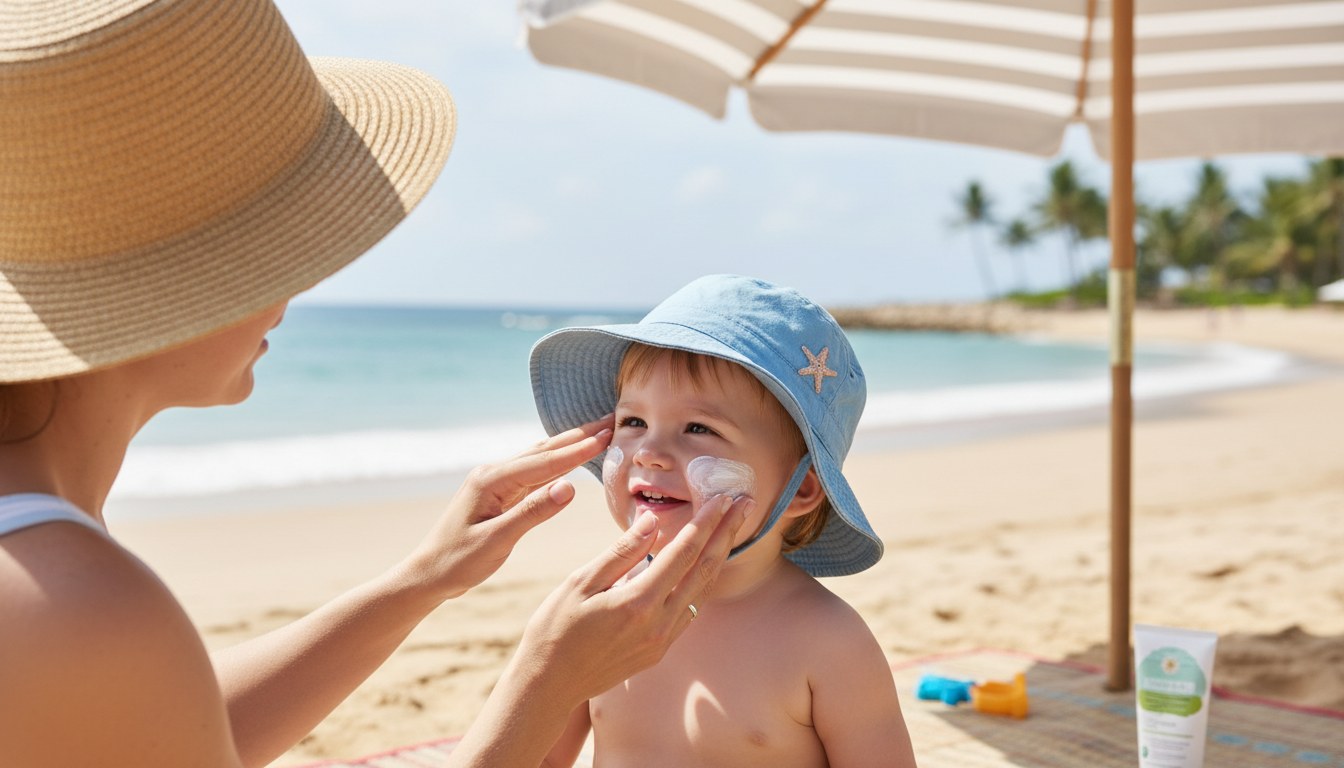
- Use a generous layer on every exposed area, including ears, back of the neck, tops of the feet, backs of the knees, and the part in the hair or scalp if hair is thin.
- For the face, put lotion on your own hands first and pat it on gently, keeping it away from the eyes and mouth.
- Reapply on the schedule printed on the label, which is commonly about every two hours, and after swimming, heavy sweating, or towel drying.
- Wash your hands afterward so product does not get into your own eyes or onto food.
Children wriggle, so a second pair of hands, a distraction such as a song, or applying after bath time while they are calm can help. Make sunscreen a routine like buckling a seat belt, and children tend to accept it more readily as they grow.
Sunscreen is one layer: the rest of sun protection
Sunscreen works best alongside other measures, and the others do not need to be reapplied:
- Sun-protective clothing: swim shirts and rash guards with an ultraviolet protection factor (UPF) label cover large areas without extra product.
- Hats: a wide brim protects the face, ears, and neck better than a baseball cap.
- Sunglasses: UV can affect the eyes too. MedlinePlus lists eyewear information that includes sun protection for the eyes, and child-sized sunglasses that block UV are available.
- Timing and shade: the sun is usually strongest in the middle of the day, so shade breaks and indoor play during those hours reduce exposure.
- Cloudy days: a good deal of UV can pass through clouds, so a cloudy sky does not remove the need for protection.
Water, sand, and snow
Water, sand, and snow reflect UV light, so a child can burn even while sitting under an umbrella. Wet skin also washes sunscreen off. Check your child's skin at the end of a beach day, and pay attention to the shoulders, nose, and tops of the feet.
Sensitive skin, eczema, and rashes
Children with eczema or easily irritated skin may sting or flare with some sunscreens. Our guide on childhood eczema covers triggers and daily care, and the same principles apply here: choose fragrance-free products and avoid new products during a flare when you can.
If you are trying a new sunscreen, you can test a small amount on the inner forearm for a day or so before using it widely. Redness, itching, bumps, or blistering may suggest a reaction, and you can stop that product and ask your pediatrician about alternatives. Our article on common childhood rashes can help you tell a sunscreen reaction from other causes, though only a clinician can diagnose a rash.
Some children with certain medical conditions or on certain medicines are more sensitive to sunlight. MedlinePlus lists skin conditions in one place. If your child takes a prescription medicine, ask the prescriber or pharmacist whether it can increase sun sensitivity, and do not change the medicine yourself.
Sprays, homemade products, and "natural" claims
Spray sunscreens
Aerosol and pump sprays are convenient, but it is easy to miss spots and to apply too little. Sprays can also be breathed in, which is a concern for small children. If you use one, spray it onto your hands and rub it on, away from the face, rather than spraying directly near your child's nose and mouth. Keep sprays away from flames and heat, as many are flammable until dry.
Homemade sunscreen
Recipes online often combine oils, butters, and zinc oxide powder. A systematic review in PubMed Central on the rise of homemade sunscreen trends raises concern that these products may not provide reliable or measurable protection and may increase skin cancer risk when used in place of tested products. Because the level of protection cannot be verified, a tested commercial product is a safer choice for children.
"Natural" or "reef safe" labels
These terms are not a guarantee of safety or of protection. Look at the active ingredients and the SPF and broad-spectrum statements instead.
Makeup, moisturizer, and tinted products
Daily moisturizers or cosmetics that contain SPF may not be applied thickly enough to give the labeled protection. For longer time outdoors, a dedicated sunscreen is generally a better choice.
If your child gets sunburned
A mild sunburn usually appears as red, warm, tender skin that develops after sun exposure and peaks over a day or so. Cool (not ice-cold) baths or damp cloths, gentle fragrance-free moisturizer, extra fluids, and shade can make a child more comfortable. Keep the burned skin covered and out of the sun until it heals. Do not pop blisters, since they protect the skin underneath.
Ask your pediatrician or pharmacist which pain reliever is right for your child and what the label says about dosing, since dosing for children depends on age and weight and the product label must be followed. Our comparison of ibuprofen and acetaminophen covers general differences between these medicines.
A burn that covers a large area, blisters widely, or is accompanied by fever, chills, vomiting, or unusual sleepiness needs a clinician's evaluation. Heavy sun exposure can also cause dehydration and heat illness. Our guide on telling if your child is dehydrated lists the signs to watch for, such as fewer wet diapers, dry mouth, and unusual tiredness.
Heat illness and allergic reactions: the signs that cannot wait
Severe heat illness (heat stroke) can occur in children playing or resting in hot conditions, especially in a parked car. Warning signs include very hot skin, confusion, unusual drowsiness, a child who is hard to wake, fainting, or seizures. This is an emergency, so call 911 and move the child to a cooler place while you wait.
A serious allergic reaction to sunscreen is uncommon, but swelling of the lips, tongue, or face, trouble breathing, or widespread hives after applying a product need emergency care. If a child swallows sunscreen or gets it in the eyes, rinse the eyes with water and call Poison Control at 1-800-222-1222. Call 911 if the child has trouble breathing, collapses, or cannot be woken.
Questions to bring to your pediatrician
- Is a mineral sunscreen appropriate for my baby, and which product do you suggest?
- Does any medicine my child takes increase sun sensitivity?
- How should we protect my child's skin if they have eczema or a history of reactions?
- Does my family's skin cancer history change how careful we should be?
- Are there skin checks you recommend as my child grows?
Children with darker skin can burn and can be harmed by UV exposure, even though they may burn less quickly. A survey study in PubMed Central on sunscreen awareness in people with skin of color found low awareness and common misconceptions, which is a reminder that sun protection applies to every skin tone.
When to Seek Medical Care
When to Seek Urgent or Emergency Care
Sun exposure in children can lead to heat illness or, less often, a serious allergic reaction. These signs need emergency care, while other sunburn problems still call for prompt medical attention. This guidance is in addition to, not a replacement for, the general disclaimer above.
Emergency, call 911 or go to the emergency room immediately if:
- Your child has very hot skin, confusion, extreme drowsiness, fainting, or a seizure after time in the heat or a hot car, which can be signs of heat stroke.
- Your child has trouble breathing, wheezing, or throat tightness after sunscreen was applied or swallowed, which can be a serious allergic reaction.
- Your child has swelling of the lips, tongue, or face, or widespread hives, together with dizziness or pale, floppy behavior after using a product.
- Your child has swallowed sunscreen and cannot be woken, is collapsing, or is breathing poorly, even before you reach Poison Control.
- Your baby is limp, very hard to wake, or not responding normally after being in the sun or heat.
See a doctor soon (same-day or next available appointment) if:
- Your child has a sunburn with widespread blistering, or burned skin over a large part of the body, and needs a clinician's evaluation the same day.
- Your child has a sunburn along with fever, chills, vomiting, or unusual sleepiness, which may suggest dehydration or a more serious burn.
- Your baby under 6 months has any sunburn, because young infant skin is thin and a clinician can advise on care.
- Your child shows signs of dehydration, such as very few wet diapers, a dry mouth, no tears, or unusual tiredness after time outside.
- A rash, redness, or blistering appears after a sunscreen, and it spreads or does not improve after you stop the product.
- Your child swallowed sunscreen or got it in the eyes and is awake and breathing normally, so call Poison Control at 1-800-222-1222 for guidance.
Frequently Asked Questions
Can I put sunscreen on a newborn?
For infants under 6 months, pediatric guidance generally favors shade, hats, and lightweight clothing rather than sunscreen. If your baby cannot be kept covered, many pediatricians accept a small amount of mineral sunscreen on exposed skin such as the face and hands. Ask your baby's pediatrician what they recommend for your child first.
Is mineral sunscreen better than chemical sunscreen for kids?
Both types can protect children. Mineral sunscreens with zinc oxide or titanium dioxide sit on the skin surface and are often better tolerated on sensitive skin, so many pediatric clinicians prefer them for babies. They may leave a white cast. The best sunscreen is one your child tolerates and that you will actually apply generously.
What SPF should I choose for my child?
Look for a broad-spectrum, water-resistant sunscreen labeled SPF 30 or higher. Higher numbers can offer somewhat more protection against sunburn, but the amount you apply and how often you reapply matter just as much. Check the label for the reapplication interval, and ask your pediatrician about any product questions.
How often should I reapply sunscreen on my child?
Follow the directions on your product label, which commonly call for reapplying about every two hours, and again after swimming, sweating heavily, or drying with a towel. Water-resistant products still wash off over time. Shade, hats, and protective clothing reduce how much you depend on frequent reapplication.
Is it safe to use adult sunscreen on a child?
Many adult sunscreens can be used on older children if the formula is broad-spectrum and the child tolerates it. Some adult products have fragrances or alcohol that may sting sensitive skin. A fragrance-free mineral product is usually a gentler choice. Check the label and ask your pediatrician or pharmacist if you have questions.
Can my child be allergic to sunscreen?
Yes, some children develop redness, itching, or bumps from certain ingredients or fragrances. Testing a small amount on the inner forearm before widespread use may help you spot a reaction. If a rash appears, stop the product and talk with your pediatrician. Swelling of the face or trouble breathing needs emergency care.
Is homemade sunscreen a safe option for kids?
Homemade sunscreens are not a reliable choice. A systematic review on homemade sunscreen trends raised concern that they may not give measurable protection, and the actual protection of a home recipe cannot be verified. A tested commercial product with a labeled SPF is a safer way to protect a child's skin.
Do children with darker skin need sunscreen?
Yes. Darker skin may burn less easily, but UV exposure can still damage it, and sunburn can occur. Shade, clothing, hats, sunglasses, and sunscreen are reasonable for every skin tone. Ask your pediatrician if you have questions about your child's skin and sun protection.
Related articles
Childhood Eczema: Triggers, Symptoms, and ManagementCommon Childhood Rashes: Identification, Causes, and CareHow to Tell If Your Child Is DehydratedSources
- MedlinePlus (NIH) - Tanning
- MedlinePlus (NIH) - Skin Conditions
- MedlinePlus (NIH) - Eyewear
- PubMed Central (NIH) - Sunscreening agents: a review
- PubMed Central (NIH) - The Rise in Homemade Sunscreen Trends and Future Impacts on Skin Cancer Risk: Systematic Review
- PubMed Central (NIH) - Low Sunscreen Awareness and Misconceptions in Skin of Colour With Acne-Related Post-Inflammatory Hyperpigmentation: A Cross-Sectional Study Highlighting the Need for Targeted Education
- PubMed Central (NIH) - Sunscreens and Photoaging: A Review of Current Literature