Osteoarthritis: Causes, Symptoms, and Management
Osteoarthritis (OA) is the most common form of arthritis and a leading cause of chronic pain and disability worldwide. It affects an estimated 32.5 million adults in the United States.
Written By: DocAi Health Editorial Team
Last Updated: 2026-07-13
Osteoarthritis (OA) is the most common form of arthritis and a leading cause of chronic pain and disability worldwide. It affects an estimated 32.5 million adults in the United States. Once described as simple "wear and tear," osteoarthritis is now understood as a complex disease of the entire joint, involving cartilage breakdown, bone remodeling, joint space narrowing, and synovial inflammation. It most commonly affects the knees, hips, hands, and spine. While OA is not curable, its progression can be slowed and symptoms effectively managed with the right combination of interventions.
What Is Osteoarthritis?
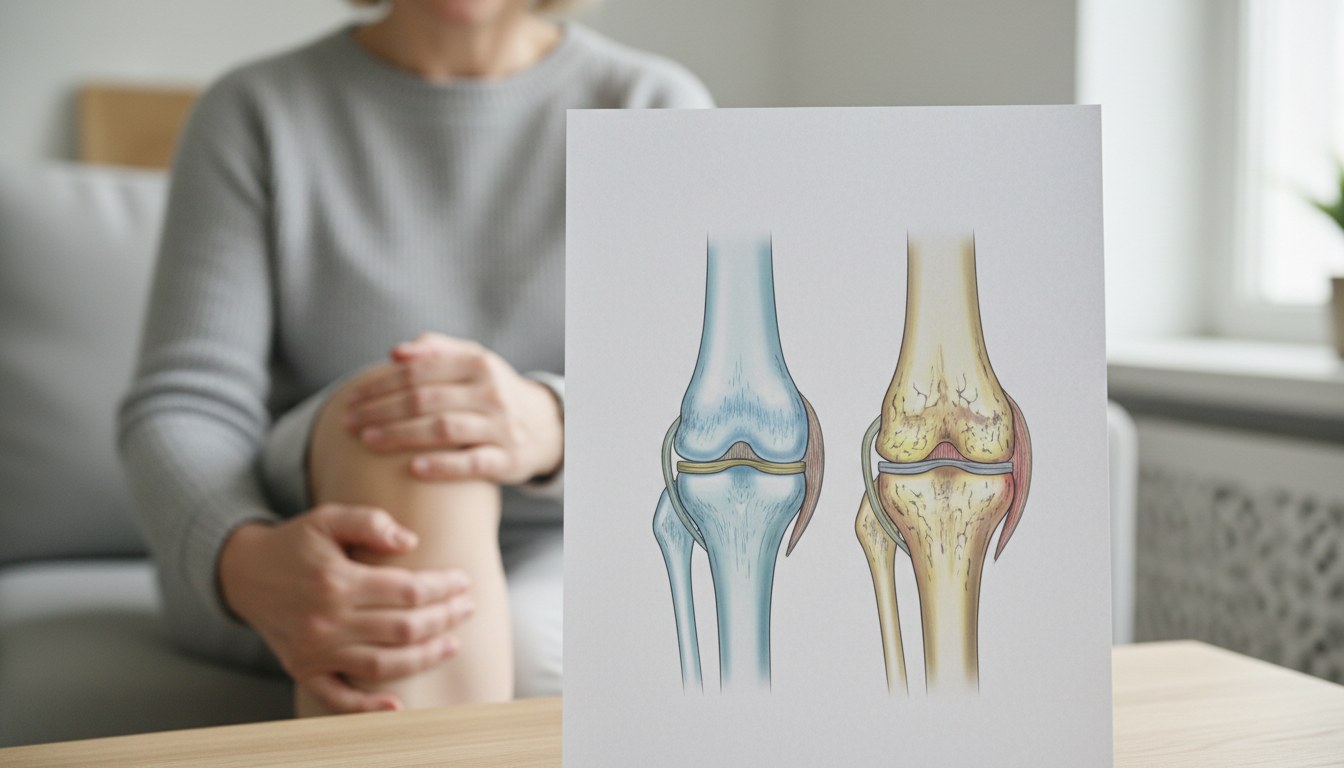
Healthy joints are cushioned by articular cartilage, smooth, elastic tissue covering the ends of bones at the joint surface. Cartilage allows bones to glide smoothly against each other during movement and absorbs shock. In osteoarthritis, the cartilage gradually breaks down and loses its protective properties. As cartilage thins and wears away, the underlying bone is exposed. The body responds to this breakdown by generating bone spurs (osteophytes), narrowing the joint space, and triggering inflammatory changes in the synovial membrane (joint lining). The result: pain, stiffness, swelling, and eventual loss of joint function.
Causes and Risk Factors
Age, The Strongest Risk Factor
Cartilage's ability to repair itself declines with age. The prevalence of OA increases markedly with age, particularly after 45-50. Aging-related changes in cartilage composition, reduced collagen synthesis, and decreased joint proprioception all contribute.
Obesity
Excess body weight dramatically increases mechanical load on weight-bearing joints. For knee OA specifically, each pound of body weight translates to 4 pounds of force on the knee joint during walking. Beyond mechanical load, adipose tissue releases inflammatory cytokines (adipokines) that directly damage cartilage. Weight loss is the single most effective non-surgical intervention for knee OA.
Previous Joint Injury
Traumatic injury to a joint, ACL tear, meniscal tear, fracture into the joint surface, significantly accelerates cartilage breakdown and greatly increases OA risk years after the injury, even when fully healed. Post-traumatic OA accounts for a substantial proportion of early-onset OA in young active adults.
Occupational and Activity-Related Factors
Physically demanding occupations that involve repetitive joint loading, prolonged kneeling, squatting, or heavy lifting increase OA risk in specific joints. Construction workers, farmers, miners, and flooring installers are among those with elevated occupational OA risk.
Genetics
OA has a significant heritable component, particularly for hand and hip OA. Multiple genes affecting cartilage structure, collagen synthesis, and bone metabolism contribute to genetic susceptibility.
Sex
Women develop OA at higher rates than men, particularly after menopause, suggesting a role for estrogen in joint health. Women are at significantly higher risk for knee, hand, and finger OA.
Malalignment
Abnormal joint alignment (e.g., genu varum, "bow-legged" alignment, in knee OA) concentrates stress on one compartment of the joint, accelerating focal cartilage loss.
Symptoms of Osteoarthritis
- Joint pain: Typically aching, worse with use or at the end of the day, and relieved by rest (unlike inflammatory arthritis, which is worse with rest/inactivity)
- Morning stiffness: Brief stiffness after being still, typically lasting less than 30 minutes (contrast with rheumatoid arthritis, where morning stiffness lasts over an hour)
- Reduced range of motion: The joint gradually becomes less flexible and more limited in movement
- Crepitus: Cracking, popping, or grinding sounds or sensations with movement
- Joint swelling: From synovial fluid accumulation (joint effusion) or bony enlargement at the joint margins
- Bony enlargements: Heberden's nodes (distal finger joints) and Bouchard's nodes (middle finger joints) are characteristic of hand OA
- Functional limitation: Difficulty with stairs, rising from chairs, walking, gripping, or fine motor tasks depending on the affected joints
Management: Non-Surgical Approaches (First Line)
Exercise, The Most Evidence-Supported Intervention
Regular exercise is the cornerstone of OA management and has the strongest evidence of any non-pharmacological treatment. Contrary to concern about "wearing out" joints, appropriate exercise strengthens muscles that support and stabilize joints, reduces pain, and improves function. Both aerobic exercise (walking, swimming, cycling) and strength training are beneficial. Low-impact activities are generally preferred for weight-bearing joints.
Weight Loss
For overweight patients with knee or hip OA, weight loss of 10% or more reduces pain significantly and may slow structural progression. The Arthritis Foundation recommends weight loss as a priority intervention for overweight patients with OA.
Physical Therapy
Physical therapy provides personalized exercise programs, manual therapy, and education. For knee OA, targeted quadriceps strengthening is particularly effective. PT also teaches joint protection strategies and activity modifications.
Medications
Topical NSAIDs (diclofenac gel): First-line for knee and hand OA in patients who can tolerate topical application, effective, with minimal systemic absorption and GI side effects. Recommended before oral NSAIDs by many guidelines.
Oral NSAIDs (ibuprofen, naproxen): Effective for OA pain. Long-term use carries GI, kidney, and cardiovascular risks. Should be used at the lowest effective dose for the shortest necessary time. Add a PPI for GI protection in higher-risk patients.
Acetaminophen: Modest efficacy for OA pain; preferable for patients with contraindications to NSAIDs.
Intra-articular corticosteroid injections: Can provide 4-12 weeks of meaningful pain relief for joint flares. Not intended for frequent repeated use due to potential long-term cartilage effects.
Intra-articular hyaluronic acid: More controversial, guidelines are inconsistent; may benefit a subset of patients with knee OA.
Assistive Devices and Supports
Knee braces (particularly valgus unloader braces for medial knee OA), orthotics, canes, and walking aids reduce joint load and improve stability and function.
When Is Surgery Considered?
Joint replacement surgery (arthroplasty), most commonly total knee or total hip replacement, is considered when OA causes severe pain and functional limitation that significantly impairs quality of life and does not adequately respond to non-surgical management. It is highly effective: over 90% of patients report significant pain relief and improved function. The timing of surgery depends on individual function, pain severity, and patient goals, not age alone.
When to Seek Medical Care
Osteoarthritis itself is managed on a routine basis, but a few joint symptoms point to a different, more urgent problem. Use the guidance below to tell them apart.
Emergency, call 911 or go to the emergency room immediately: If a single joint suddenly becomes hot, red, swollen, and very painful, together with fever, this combination can indicate a joint infection (septic arthritis). This is a medical emergency, delayed treatment can cause permanent joint damage and life-threatening infection. Do not wait for a routine appointment; seek emergency care the same day.
See a doctor soon (non-urgent, but worth prompt discussion): Prolonged morning stiffness (>1 hour), several joints affected symmetrically, unexplained weight loss, or joint problems appearing in younger people without a prior injury. These features suggest inflammatory arthritis or another diagnosis and warrant evaluation by your doctor, schedule an appointment rather than waiting for your next routine visit.
Monitor at home: Typical OA pain that is worst with use and eases with rest, with brief morning stiffness, is reasonable to manage at home with the measures described above. Re-evaluate with your provider if pain steadily worsens, starts waking you at night, or begins limiting daily activities.
Frequently Asked Questions
Is osteoarthritis the same as rheumatoid arthritis?
No. Osteoarthritis is a degenerative joint disease driven by mechanical wear, aging, and metabolic factors, primarily affecting cartilage. Rheumatoid arthritis is an autoimmune disease in which the immune system attacks the synovial membrane of joints, causing severe inflammation, erosion, and joint destruction. RA often affects many joints symmetrically and can attack organs beyond joints; OA is typically focal and does not have systemic involvement. Morning stiffness lasting more than an hour suggests inflammatory arthritis rather than OA.
Does cold weather make osteoarthritis worse?
Many OA patients report increased pain during cold or damp weather. Research is mixed on the mechanism, but changes in barometric pressure may affect joint tissue pressure. While weather effects are real for some people, they do not change the disease course and are managed with the same standard approaches.
Can glucosamine and chondroitin supplements help?
Evidence is mixed. Large trials (GAIT trial) found glucosamine/chondroitin was not significantly better than placebo for most OA patients, though a subgroup with moderate-to-severe knee pain may benefit. Guidelines vary, the American College of Rheumatology currently does not strongly recommend them, but they are safe and some patients report benefit. The decision to try them is reasonable with appropriate expectations.
Will exercise make osteoarthritis worse?
No, appropriate exercise does not worsen OA and is one of the most beneficial interventions. High-impact activities (running on hard surfaces, jumping) in joints with severe established OA may aggravate symptoms, but low- to moderate-impact exercise consistently improves pain and function. Staying sedentary is harmful, it allows muscle weakness that increases joint stress. The key is choosing appropriate types and intensities of activity.
How do I know if my joint pain is OA or something more serious?
Classic OA features: pain worst with use, better with rest; brief morning stiffness; affects commonly involved joints (knees, hips, hands, base of thumb, spine); no systemic symptoms.
Sources
- CDC - Osteoarthritis
- National Institute of Arthritis and Musculoskeletal and Skin Diseases (NIAMS, NIH) - Osteoarthritis
- American College of Rheumatology - 2019 Guideline for the Management of Osteoarthritis of the Hand, Hip, and Knee
- Arthritis Foundation - Osteoarthritis: Symptoms, Diagnosis, and Treatment
- Mayo Clinic - Osteoarthritis - Symptoms & causes - Mayo Clinic