Childhood Eczema: Triggers, Symptoms, and Management
Childhood eczema, known medically as atopic dermatitis, is a long-term skin condition that leaves patches of skin dry, itchy, and inflamed, often on the cheeks, elbow creases, and behind the knees. It is not contagious and it is not caused by anything a parent did.
Children's HealthChildhood Eczemamanagement
Written By: DocAi Health Editorial Team
Last Updated: 2026-08-26
Medically Reviewed By: DocAi Health Medical Review Team
Last Updated: 2026-08-26
Medically Reviewed By: DocAi Health Medical Review Team
Medical Disclaimer: This article is for general informational and educational purposes only and is not medical advice. It does not create a doctor-patient relationship and is not a substitute for professional diagnosis or treatment by a qualified healthcare provider. Never disregard or delay seeking professional medical advice because of something you have read here. If you think you may have a medical emergency, call 911 or your local emergency number right away. Health information can change and this guidance is general and US-focused, so consult a licensed clinician in your own country about your specific situation.
Childhood eczema, known medically as atopic dermatitis, is a long-term skin condition that leaves patches of skin dry, itchy, and inflamed, often on the cheeks, elbow creases, and behind the knees. It is not contagious and it is not caused by anything a parent did. Most children with eczema have periods of clear or nearly clear skin interrupted by flares, and the pattern usually follows a mix of dry air, irritating fabrics or soaps, sweat, and sometimes food or environmental allergies. This article covers what typically triggers a flare, how to tell ordinary eczema from a skin infection, and the daily routine that keeps most children's skin under control without prescription medication.
What Is Happening to the Skin
Children with eczema are born with a skin barrier that lets moisture escape more easily than typical skin and lets irritants and allergens in more easily. The outer layer of skin is like a brick wall, with skin cells as the bricks and natural oils as the mortar. In eczema-prone skin, that mortar is thinner and gappier, so water evaporates out and irritants get in. That is why moisturizing is not a cosmetic step for these children. It is the main tool for rebuilding the barrier and reducing how often flares happen.
Genetics plays a large role. A child with a parent or sibling who has eczema, asthma, or hay fever is more likely to develop it, a pattern doctors call the atopic march. Most children who develop eczema show signs before age five, and a large share improve significantly by the teenage years as the skin barrier matures, though some carry a milder version into adulthood.
Common Triggers
A trigger does not cause eczema outright. It sets off a flare in skin that is already prone to inflammation. The most common ones parents report are:
- Dry air and temperature swings. Winter heating and summer air conditioning both pull moisture out of the air and, in turn, out of the skin.
- Sweat and overheating. Heavy pajamas, too many blankets, or vigorous play can trigger itching within minutes.
- Rough or synthetic fabrics. Wool and some stiff synthetic blends irritate sensitized skin; soft cotton is usually better tolerated.
- Soaps, bubble baths, and fragranced products. Detergents strip the skin's natural oils; fragrance is one of the most common contact irritants in children's products.
- Saliva and food residue around the mouth. Drooling and food contact can irritate the cheeks and chin in younger children, separate from a true food allergy.
- Stress. Older children can flare around exams, big transitions, or disrupted sleep, likely through the same stress hormones that affect adult skin.
- Allergens. Dust mites, pet dander, and pollen can worsen eczema in some children, though this varies a great deal from child to child.
Food allergy gets a lot of attention as an eczema trigger, but it is only clearly implicated in a minority of cases, usually in infants with moderate to severe eczema that does not respond to a good skincare routine. Do not start eliminating foods on your own. If a food allergy is suspected, ask your pediatrician about referral to an allergist for proper testing, since removing foods without evidence can create nutrition gaps and does not reliably improve the skin.
Recognizing a Flare
Eczema looks different depending on a child's age. In infants, it often shows up on the cheeks, scalp, and outer arms and legs as red, sometimes weepy patches. In toddlers and older children, it tends to settle into the creases of the elbows and knees, the wrists, ankles, and neck, appearing as dry, thickened, sometimes darker or lighter patches of skin that itch intensely. Scratching thickens the skin further over time, a change doctors call lichenification, and can make the itch worse in a cycle that is hard to break without treatment.
The itch is usually the dominant symptom parents describe, more than the redness itself. A child scratching through clothing, waking at night to scratch, or rubbing a body part against furniture is a reliable sign of an active flare even before the skin looks obviously inflamed.
A Daily Skincare Routine That Actually Helps
The routine that keeps most children's eczema under control is simple and repetitive rather than dramatic:
- Short, lukewarm baths. Around 5 to 10 minutes in lukewarm, not hot, water. Hot water and long soaks dry the skin further even though they can temporarily soothe itching.
- A gentle, fragrance-free cleanser used sparingly, only where needed, rather than a full-body soap every time.
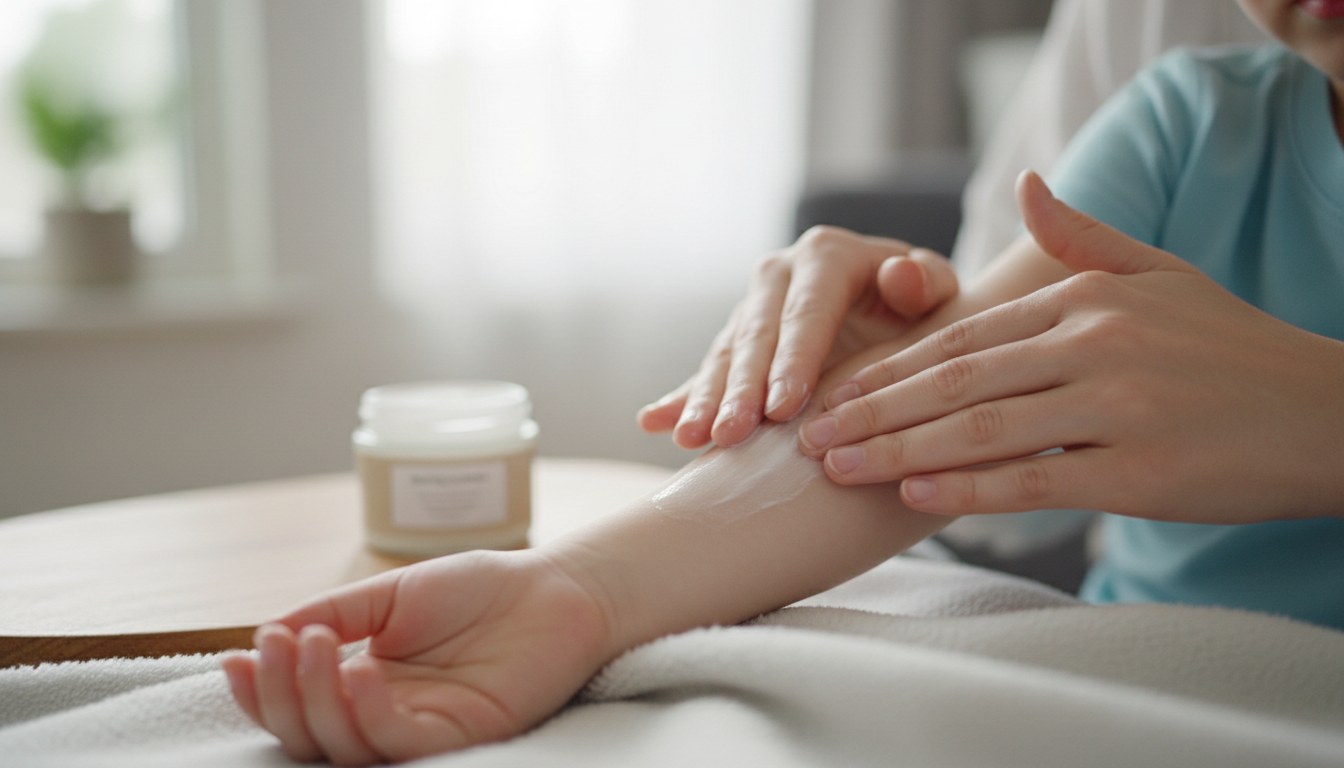
- Moisturize within three minutes of getting out of the bath, while the skin is still damp, to lock in water rather than apply cream to already-dry skin.
- Choose a thick ointment or cream over a thin lotion. Petroleum jelly-based ointments and heavy creams hold moisture in far better than water-based lotions, even though they feel greasier.
- Moisturize again at least once more during the day, and more often on visibly dry patches.
- Dress in soft, breathable cotton and wash new clothes before the first wear to remove manufacturing residue.
- Keep fingernails short to limit skin damage from scratching, and consider soft cotton sleeves or mittens at night for infants who scratch in their sleep.
Consistency matters more than any single product. Skipping the routine on clear-skin days is one of the most common reasons flares come back, because the barrier repair that keeps skin calm needs to continue even when nothing looks wrong on the surface.
When Moisturizer Is Not Enough
Many children need a prescription topical medication during flares in addition to daily moisturizing. Low-potency topical corticosteroids are the standard first step for flare-ups and are considered safe for children when used as directed by a pediatrician or dermatologist, for the prescribed number of days rather than indefinitely. Non-steroid topical medications are also available for children whose eczema does not respond well to steroids or who need longer-term maintenance therapy. Your child's clinician will match the strength and location of treatment to the severity and site of the flare, since skin on the face and in skin folds absorbs medication differently than skin on the arms or legs. Do not apply a leftover prescription cream from a previous flare or from another family member without checking with the prescribing clinician first, since strength and site instructions can differ between flares.
Breaking the Itch-Scratch Cycle
Itching triggers scratching, and scratching damages the skin barrier further, which triggers more itching. Cool compresses, distraction techniques for younger children, and keeping the home a bit cooler at night can all reduce the urge to scratch without medication. For a child who scratches through sleep, ask the pediatrician about a short course of an antihistamine at bedtime, since some formulations have a sedating effect that can help sleep even though they do not directly treat the itch itself. Avoid long-term reliance on sedating antihistamines as a fix, since the goal is calming the skin, not masking the symptom night after night.
Living With a Chronic Skin Condition
Eczema can affect more than skin comfort. Poor sleep from nighttime itching affects mood, attention, and school performance the next day, and visible patches can affect a child's confidence around peers. Talk with your child in plain language about what eczema is and is not: it is not contagious, it is not caused by being dirty, and flares are not a sign that something is being done wrong at home. Many schools will accommodate a labeled moisturizer or an epinephrine plan if a food allergy coexists, so it is worth a short conversation with the school nurse if flares are frequent or severe.
When It Might Not Be Eczema
A few other conditions look similar to eczema and are worth ruling out if a rash does not respond to a good skincare routine over a few weeks: contact dermatitis from a specific product or plant, ringworm (which tends to form a ring shape with a clearer center), scabies (which often causes intense itching in the webs of the fingers and around the waistband), and psoriasis (which tends to be more sharply bordered with silvery scale). A pediatrician or dermatologist can usually tell these apart on exam, and testing is available if the diagnosis is unclear.
When to Seek Medical Care
When to Seek Urgent or Emergency Care
Most eczema flares are managed at home with moisturizer and, when needed, a prescribed topical medication. A small number of situations mean the skin has become infected or that a reaction has moved beyond ordinary eczema, and those need prompt medical attention. This guidance is in addition to, not a replacement for, the general disclaimer above.
Emergency, call 911 or go to the emergency room immediately if:
- Your child develops widespread clusters of small, fluid-filled blisters that look punched-out or crater-shaped, especially with fever, since this can signal eczema herpeticum, a serious herpes virus infection of eczema-affected skin.
- Your child has trouble breathing, facial or lip swelling, or widespread hives after a new food, medication, or product, which can signal a severe allergic reaction (anaphylaxis).
- Your child looks seriously ill, with a high fever, extreme lethargy, or a fast heart rate alongside rapidly spreading, hot, red skin, which can signal a spreading skin infection entering the bloodstream.
- Skin around a flare turns dusky, purple, or numb, or a large area of skin blisters and peels rapidly.
See a doctor soon (same-day or next available appointment) if:
- A patch of eczema develops yellow crusting, pus-filled bumps, or increasing warmth and swelling, which are signs of a bacterial skin infection.
- A flare is not improving after a week or two of consistent moisturizing and any prescribed topical treatment, or keeps coming back in the same spot right after treatment stops.
- Itching is disrupting sleep several nights in a row and is affecting your child's mood, attention, or school performance.
- The rash is spreading well beyond its usual pattern, or new areas of the body are involved for the first time.
- You suspect a food allergy is involved, so proper allergy testing can be arranged rather than removing foods without guidance.
Frequently Asked Questions
Will my child outgrow eczema?
Many children see significant improvement by the teenage years as their skin barrier matures, and a good number have clear or nearly clear skin by then. Some carry a milder, drier-skin tendency into adulthood, and a smaller group continues to have active flares as adults. There is no reliable way to predict which path an individual child will take early on.
Is childhood eczema caused by poor hygiene?
No. Eczema comes from a skin barrier that lets moisture out and irritants in more easily than typical skin, often combined with a genetic tendency toward allergic conditions. It is not related to cleanliness, and over-washing with harsh soap can actually make it worse by stripping the skin's natural oils further.
Can eczema be cured with the right cream?
There is currently no cure for eczema, but daily moisturizing and, when needed, prescribed topical treatment can keep most children's skin calm and comfortable for long stretches. Think of the routine as ongoing management rather than a one-time fix, similar to how asthma is managed rather than cured.
Should I stop bathing my child during a flare?
No, a short lukewarm bath is usually part of the solution rather than the problem, as long as it is followed immediately by moisturizer while the skin is still damp. What tends to worsen eczema is a long, hot bath or harsh soap, not bathing itself. Ask your pediatrician if you are unsure about bathing frequency for a specific flare.
How do I know if my child's eczema is infected?
Watch for yellow crusting, pus-filled bumps, increasing warmth, swelling, or pain in a patch that had previously just been dry and itchy. A fever alongside these skin changes raises the concern further. Any of these signs is a reason to have the skin checked by a clinician rather than continuing the usual routine alone.
Do certain foods cause eczema flares?
In most children, food is not the main driver of eczema, and diet changes made without guidance rarely improve the skin. Food allergy is more often relevant in infants with moderate to severe eczema that is not responding to good skincare. If you suspect a food connection, ask your pediatrician about allergy testing rather than removing foods on your own.
What is the best moisturizer for a child with eczema?
Thick, fragrance-free ointments and creams generally work better than thin lotions because they hold moisture in the skin more effectively. Petroleum jelly is an inexpensive, well-tolerated option many families use. The best choice is often whichever fragrance-free option your child will tolerate consistently, since a moisturizer only helps if it gets applied every day.
Can stress make a child's eczema worse?
Yes, older children and teenagers sometimes notice flares around exams, family changes, or disrupted routines, likely tied to stress-related changes in the body that also affect the skin. Addressing sleep, routine, and emotional support alongside the skincare routine can help reduce flare frequency in these cases.
Related articles
Common Childhood Rashes: Identification, Causes, and CareHand, Foot, and Mouth Disease: Symptoms and CareFever in Children: Causes, When to Worry, and When to WaitSources
- NIAMS (NIH) - Atopic Dermatitis (Eczema)
- MedlinePlus (NIH) - Eczema
- Mayo Clinic - Atopic dermatitis (eczema)
- NICHD (NIH) - Skin Conditions and Diseases