When Should Older Women Get a Bone Density Test?
The US Preventive Services Task Force (USPSTF) recommends bone density screening for women age 65 and older. Postmenopausal women younger than 65 may also benefit when risk factors and a clinical risk assessment show an increased chance of fracture.
Senior HealthBone Health & Osteoporosissenior-care
Written By: DocAi Health Editorial Team
Last Updated: 2026-09-30
Last Updated: 2026-09-30
Medical Disclaimer: This article is for general informational and educational purposes only and is not medical advice. It does not create a doctor-patient relationship and is not a substitute for professional diagnosis or treatment by a qualified healthcare provider. Never disregard or delay seeking professional medical advice because of something you have read here. If you think you may have a medical emergency, call 911 or your local emergency number right away. Health information can change and this guidance is general and US-focused, so consult a licensed clinician in your own country about your specific situation.
The US Preventive Services Task Force (USPSTF) recommends bone density screening for women age 65 and older. Postmenopausal women younger than 65 may also benefit when risk factors and a clinical risk assessment show an increased chance of fracture. A prior fracture from a minor fall, or long-term steroid use, can call for a bone health evaluation on its own. A bone density test, or DXA scan, is a quick, noninvasive scan that measures the mineral in your bones and helps your clinician estimate your risk of a future fracture.
What a Bone Density Test Actually Measures
A bone density test, formally called a DXA scan (dual energy x-ray absorptiometry, sometimes written DEXA), uses a very low dose of radiation to measure how tightly packed the mineral is inside your bones. A central DXA scan typically measures bone density at the hip and lumbar spine, key sites used to assess osteoporosis and fracture risk. MedlinePlus explains that postmenopausal women receive a T-score, which compares your bone density with that of a healthy young adult of the same sex.
A T-score of -1.0 or higher is considered normal. A score lower than -1.0 but above -2.5 is osteopenia, meaning bone density is lower than a healthy young adult's but not yet in the osteoporosis range. A score of -2.5 or lower meets the definition of osteoporosis. No single number tells you whether or when a fracture will happen; the score helps your clinician estimate how much your fracture risk has increased.
For women who have not yet gone through menopause, the report uses a Z-score, which compares your bones with those of other people your own age and sex. A Z-score of -2.0 or lower is described as below the expected range for age and can prompt blood tests for a treatable cause, such as a thyroid problem or a vitamin D deficiency, before a bone medication is considered.
The Standard Age to Start Screening
For women with no particular risk factors, the USPSTF points to age 65 as the age to get a first bone density test. Bone loss speeds up in the years after menopause, when estrogen, a hormone that helps slow bone breakdown, drops. Fracture risk keeps rising with age, so a first scan at 65 gives your clinician a baseline to work from.
For postmenopausal women younger than 65, the USPSTF suggests first checking for osteoporosis risk factors and then using a clinical risk assessment tool to estimate fracture risk; screening is recommended when that estimate is increased. Waiting until 65 is a default for average risk, not a rule that fits everyone.
Fracture risk calculators such as FRAX combine factors like age, weight, smoking status, alcohol use, family history, and prior fracture into an estimate of your chance of a fracture over the next ten years. If your clinician brings one up alongside your T-score, it reflects that the scan is only one part of the full picture.
When Testing Before 65 May Make Sense
Several things can move the testing conversation earlier than 65:
- Menopause before age 45, or surgical removal of both ovaries at a young age, which cuts off estrogen years earlier than a typical menopause.
- A parent who broke a hip, which is linked to a higher fracture risk for you.
- A fracture as an adult from a fall or bump that would not normally break a bone, most often in the wrist, spine, or hip, sometimes called a fragility fracture.
- Long-term use of a corticosteroid such as prednisone, which can thin bone over months of use.
- A medical condition linked to bone loss, including rheumatoid arthritis, celiac disease, inflammatory bowel disease, or an overactive thyroid or parathyroid gland.
- Low body weight, heavy alcohol use, or smoking, each of which is linked to lower bone density.
If one or more of these risk factors applies to you, ask your clinician whether a formal fracture-risk assessment or earlier DXA testing is appropriate. Risk factors do not always come up at a routine visit, so mentioning them yourself helps.
A prior fragility fracture or long-term use of a medication that promotes bone loss, such as a systemic glucocorticoid, may warrant a bone health evaluation outside routine age-based screening, because the USPSTF recommendation applies to adults without known osteoporosis or fragility fractures. Steroids are often essential, so do not stop or change one on your own; ask the prescriber how to protect your bones. For more on long-term use, see Prednisone: Uses, Side Effects, Tapering and Safety.
Some pharmacies and health fairs offer a quick heel ultrasound. It can flag a woman who should follow up, but it gives less detail than a central DXA scan of the hip and spine and is not enough on its own to diagnose osteoporosis or guide treatment. If a heel scan is concerning, your clinician may recommend a central DXA scan.
What Your Results Mean, and What Happens Next
A normal T-score generally calls for no treatment, only the usual bone health habits: enough calcium and vitamin D, regular weight-bearing exercise, and avoiding smoking. Osteopenia calls for a conversation about diet, exercise, and when to repeat the test, since some women with osteopenia go on to develop osteoporosis and some do not. A T-score of -2.5 or lower typically leads to a discussion about medication that slows bone loss or helps rebuild it, on top of the same lifestyle steps. Each osteoporosis medicine has its own benefits and cautions, so the choice is made with your clinician; do not start, stop, or change one on your own.
Bone loss and muscle loss often occur together as women age, and losing muscle strength adds its own fall risk on top of thinner bones. If that side of aging concerns you, Sarcopenia: Why Older Adults Lose Muscle and What Helps covers what causes it and what helps.
How Often to Repeat the Test
The right interval for repeat DXA testing depends on your first result, your age, your fracture risk, your medications, and whether osteoporosis treatment has been started. The USPSTF reports that repeating bone density testing at an interval of 4 to 8 years did not add accuracy in predicting fractures in cohort studies, and that women with lower baseline T-scores and older women moved into the osteoporosis range over shorter intervals. A normal baseline scan may not need repeating for several years, while someone closer to the osteoporosis range, or receiving treatment, may need earlier follow-up.
The Centers for Medicare & Medicaid Services lists bone density testing as a covered preventive service once every 24 months for people who qualify, and more often when medically necessary. That is a coverage rule, not a recommendation that everyone needs a DXA scan every two years. Your clinician may bring you back sooner if you start a medication that affects bone or break a bone before your next scan.
What to Expect the Day of the Test
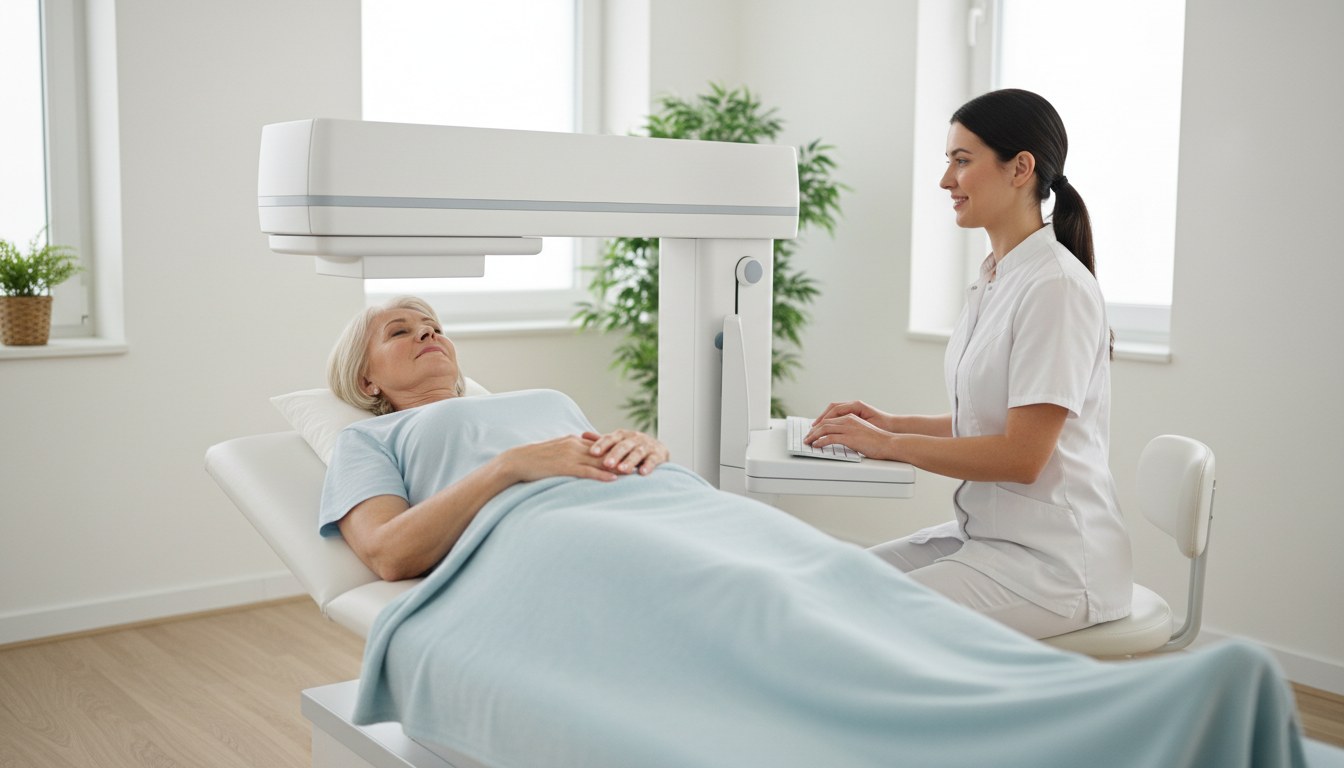
A DXA scan usually takes about 10 to 30 minutes. You typically stay clothed, aside from removing anything metal near the scan area, and lie still on a padded table while the machine passes over your hip and spine. There is no injection, no enclosed tube, and usually no need to fast. The radiation dose is very low, lower than that of a standard chest x-ray. MedlinePlus notes that you may be told to stop calcium supplements 24 to 48 hours before the test. Supplements can interfere with the reading, so ask the imaging center what to do.
Reducing Your Fracture Risk Beyond the Test
A bone density test helps estimate your risk; it does not lower it. Two things can make a real difference once you know your number: keeping your bones and muscles as strong as your body allows, and removing the everyday hazards that cause falls. Loose rugs, poor lighting, and cluttered stairways are common causes of the falls that turn thin bones into a broken hip. For a room by room walkthrough, see How to Prevent Falls at Home for Older Adults.
It is also worth reviewing your medication list with your doctor or pharmacist. Some common prescriptions, including certain sedatives, blood pressure medications, and sleep aids, increase fall risk by affecting balance or blood pressure when you stand up. Medications That Raise Fall Risk in Seniors walks through which drug classes to ask about.
Calcium and vitamin D are important for bone health at every age. Aim to meet your needs through food when possible. MedlinePlus notes that calcium-rich foods are the preferred source, that some people do need a supplement, and that higher amounts of calcium over a long period raise the risk of kidney stones in some people. Talk with a clinician about supplements if your diet falls short or you have a specific reason to take one. Can You Take Vitamin D and Calcium at the Same Time? covers how the two work together.
Weight-bearing exercise such as walking, dancing, climbing stairs, or resistance training with light weights helps keep bone strong, while balance-focused activity such as tai chi may lower the chance of the fall that would test that bone in the first place.
Recognizing a Fracture After a Fall
A broken hip typically causes pain in the hip or groin right after a fall, along with an inability to stand or bear weight on that leg; the leg may also look shorter or turn outward at an unusual angle. A small number of hip fractures hurt less at first, so hip or groin pain after a fall is worth an emergency room visit even when it seems mild.
A spinal compression fracture can cause sharp pain after a fall, a cough, or even bending over. Sudden, severe pain like this needs emergency care, especially with numbness, tingling, weakness in the legs, or loss of bladder or bowel control, any of which can mean a nerve is being compressed. Milder new back pain after such an event still deserves a prompt medical evaluation.
A fall that involves hitting the head deserves prompt attention too, especially for women taking a blood thinner, which can raise the risk of bleeding in the brain. That bleeding can build slowly, showing up as confusion, vomiting, or a worsening headache after the fall seemed minor. If you take a blood thinner and hit your head, get medical attention right away, even if you feel fine.
A hard fall to the chest can also crack a rib. Chest pain, sudden shortness of breath, or coughing up blood after a fall or a hard blow to the chest requires emergency evaluation, because a collapsed lung, bleeding, or another serious injury is possible.
Why Some Eligible Women Are Not Screened
A bone density test is quick and very low risk, yet not every eligible woman gets one. Some assume a scan is only for women who already broke a bone; others are not offered it at a routine visit unless they ask. If you are 65 or older, or younger with any of the risk factors above, and cannot remember your last test, ask your clinician whether you are due.
The Silent Part of Osteoporosis
Osteoporosis is often called a silent disease because thinning bone usually does not hurt. Many women find out they have it only after a fracture, or notice it indirectly: a gradual loss of height, or a new stoop in the upper back, can be a sign of small compression fractures in the spine that happened without a memorable moment of pain. CDC data from 2017 to 2018 found osteoporosis at the femur neck or lumbar spine in 18.8 percent of US women age 50 and older. See Early Signs of Osteoporosis Before a Fracture Happens for the clues that can appear before a bone breaks.
A hip fracture is among the most serious of these consequences. Most hip fractures need surgery, and many women face an extended hospital stay and months of rehabilitation; some do not fully regain the ability to live independently afterward. That is why screening exists: to catch bone loss early enough that lifestyle changes or medication may lower the chance of reaching that point.
When to Seek Medical Care
When to Seek Urgent or Emergency Care
A DXA scan is a noninvasive test that uses a very low dose of radiation and is generally considered very safe. The fragility fractures that screening aims to help prevent, however, can be a serious emergency for women with thin bones, especially after a fall or a sudden twisting movement. This guidance is in addition to, not a replacement for, the general disclaimer above.
Emergency, call 911 or go to the emergency room immediately if:
- You fall and have hip or groin pain, cannot put any weight on your hip or leg, or the leg looks shorter, rotated outward, or visibly deformed.
- You have sudden, severe back pain after a fall, a cough, or even bending to lift something, especially if it comes with numbness, tingling, or weakness in your legs.
- You lose control of your bladder or bowels after a fall or with new severe back pain, or you notice numbness in the groin or inner thighs.
- You hit your head in a fall and develop confusion, repeated vomiting, a worsening headache, or trouble staying awake, or you take a blood thinner and hit your head, even if you feel fine.
- You have chest pain, sudden shortness of breath, or cough up blood after a fall or a hard blow to the chest, which can signal a collapsed lung, bleeding, or another serious injury.
See a doctor soon (same-day or next available appointment) if:
- You notice you have gotten noticeably shorter, or your upper back has developed a new stoop or curve.
- You have ongoing back pain that is not clearly tied to an injury and does not improve with rest.
- You have milder new back pain after a fall, a cough, or lifting, without numbness, weakness, or bladder or bowel changes.
- You fell and have pain, swelling, or bruising in a wrist or forearm, even though you can still move and use the area.
- You are due for osteoporosis screening or follow-up based on your age, previous DXA result, fracture risk, treatment plan, or clinician's advice, you are 65 or older and have never had a bone density test, or you have a new risk factor such as a recent fracture from a minor fall or a new long-term steroid prescription.
- Your bone density report shows osteopenia or osteoporosis and you have not yet discussed a follow-up plan with your doctor.
Frequently Asked Questions
What age should a woman get her first bone density test?
The USPSTF recommends bone density screening for women 65 and older. Postmenopausal women younger than 65 may also be screened when risk factors such as early menopause or a parent who broke a hip, plus a clinical risk assessment, show an increased chance of fracture. A prior fragility fracture or long-term steroid use may call for a bone health evaluation on its own, so mention these to your clinician.
Does insurance or Medicare cover a bone density test?
Medicare Part B covers a bone density test once every 24 months, and more often when medically necessary, for people who meet certain conditions, such as a woman whose doctor finds she is estrogen deficient and at risk for osteoporosis, or a person taking steroid medication. That is a coverage rule, not a medical recommendation to repeat the scan every two years. Private plans vary, so check with your insurer before scheduling.
Is a bone density test painful, and how much radiation does it use?
A DXA scan is not painful. You lie still on a padded table, usually for about 10 to 30 minutes, while a machine passes over your hip and spine, with no needles and nothing inserted into your body. The radiation dose is very low, lower than that of a standard chest x-ray, and no recovery time is needed afterward.
What is the difference between osteopenia and osteoporosis?
Both describe bone density lower than a healthy young adult's, measured on the same T-score scale in postmenopausal women. Osteopenia, or low bone mass, is the milder stage, a T-score lower than -1.0 but higher than -2.5. Osteoporosis is diagnosed at a T-score of -2.5 or lower. Whether medication makes sense depends on your overall fracture risk, not the score alone.
Can a bone density test really predict a future fracture?
It cannot predict exactly when or if a fracture will happen, but a lower T-score is linked to higher fracture risk, which is why clinicians use it alongside your age, fall history, and other risk factors to decide how closely to monitor you and whether medication makes sense for your situation.
Should a woman get a bone density test before menopause?
Routine screening before menopause is not standard, since bone loss speeds up afterward. Testing earlier can make sense with a strong family history of osteoporosis, long-term steroid use, a condition like celiac disease or rheumatoid arthritis, or ovaries removed at a young age. Before menopause, results are usually reported as Z-scores rather than T-scores. Ask your clinician whether your history warrants testing.
How should I prepare for a bone density test appointment?
Wear comfortable clothing without metal zippers, buttons, or belt buckles near your hips and midsection, since metal can interfere with the scan. Ask the imaging center whether to hold calcium supplements first; MedlinePlus notes that you may be told to stop them 24 to 48 hours before the test. No fasting is usually needed, and you can generally drive yourself home afterward, since the test does not affect alertness or coordination.
What happens if my bone density test result comes back abnormal?
An osteopenia or osteoporosis result is a reason to make a plan with your clinician, not an emergency. Your clinician will typically review your calcium and vitamin D intake, discuss weight-bearing exercise, look at your fall risk, and decide whether a bone-strengthening medication fits your situation. Many women manage a low bone density result with a mix of lifestyle changes, medication when it is appropriate, and follow-up monitoring.
Related articles
How to Prevent Falls at Home for Older AdultsMedications That Raise Fall Risk in SeniorsSarcopenia: Why Older Adults Lose Muscle and What HelpsSources
- US Preventive Services Task Force - Osteoporosis to Prevent Fractures: Screening
- MedlinePlus (NIH) - Osteoporosis
- MedlinePlus (NIH) - Bone Density Scan
- MedlinePlus (NIH) - Calcium in diet
- National Institute of Arthritis and Musculoskeletal and Skin Diseases (NIH) - Osteoporosis
- Mayo Clinic - Bone density test
- CDC - FastStats: Osteoporosis
- Centers for Medicare & Medicaid Services - Medicare Preventive Services