Common Childhood Rashes: Identification, Causes, and Care
Skin rashes are among the most common reasons children are brought to the pediatrician. Most childhood rashes are benign, self-limiting, and manageable at home, but a few require prompt medical attention.
Written By: DocAi Health Editorial Team
Last Updated: 2026-07-13
Skin rashes are among the most common reasons children are brought to the pediatrician. Most childhood rashes are benign, self-limiting, and manageable at home, but a few require prompt medical attention. Knowing how to recognize common childhood rashes, their typical appearance, associated symptoms, and usual course, helps parents respond appropriately: with calm management at home or urgent medical care when needed.
The Most Important Question: Does the Rash Blanch?
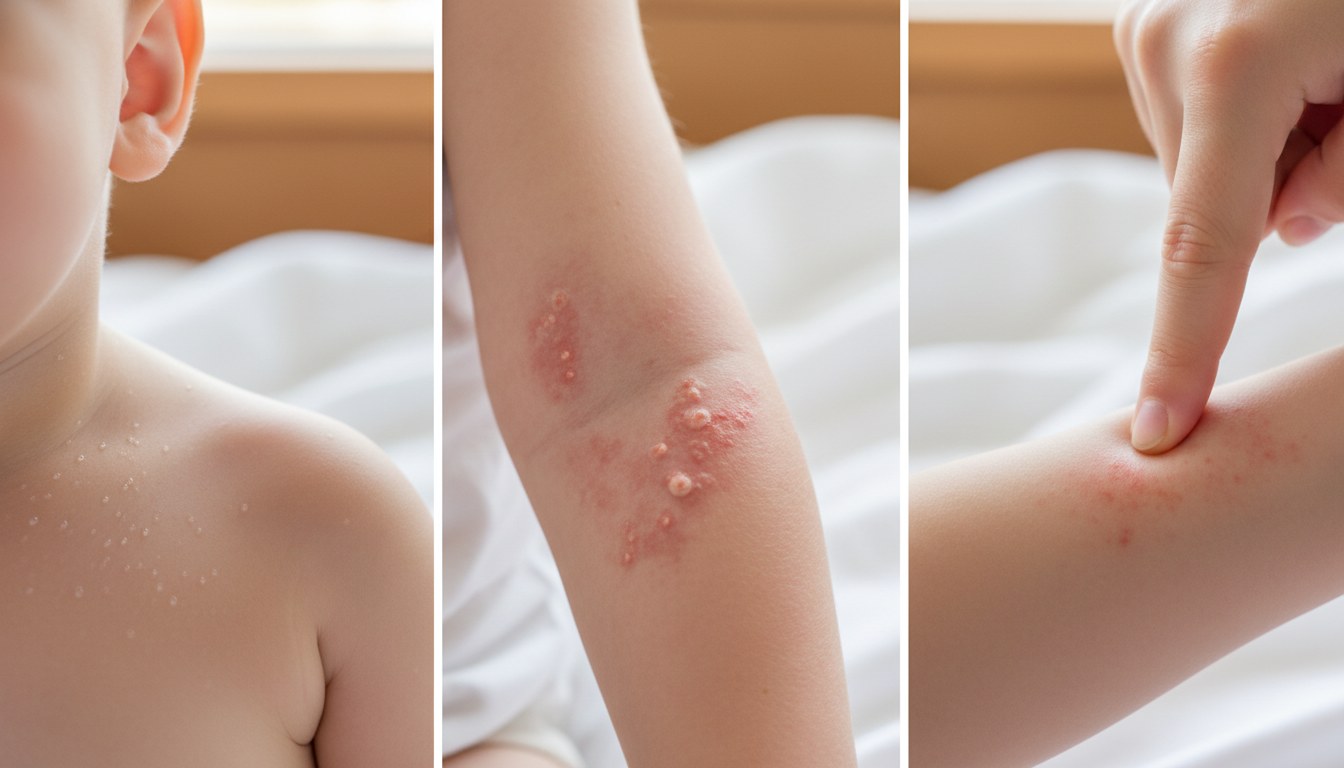
Before describing specific rashes, the single most important assessment: the blanch test. Press a clear glass or finger firmly against the rash for 2-3 seconds. If it fades to white (blanches), it is almost always benign, caused by dilated blood vessels that can be compressed. If it does NOT blanch (the color remains under pressure), it may indicate bleeding into the skin from damaged vessels, a potential sign of meningococcal septicemia or other serious conditions requiring immediate emergency care. This applies to any age, any rash.
Eczema (Atopic Dermatitis)
What It Is
The most common chronic childhood skin condition, affecting 10-20% of children. Eczema is an inflammatory skin condition characterized by a dysfunctional skin barrier that loses moisture easily and reacts to triggers with intense itching and redness.
Appearance
Dry, red, intensely itchy patches. In infants: cheeks, scalp, and outer extremities. In older children: elbow creases, behind knees, wrists, ankles. May weep fluid when severely inflamed (wet eczema) or become thickened and leathery (lichenified) with chronic scratching.
Triggers and Treatment
Common triggers: dry air, frequent bathing without moisturizing, certain soaps, wool, pet dander, sweat. Management: regular thick moisturizing (immediately after bathing while skin is damp), gentle cleansers, avoiding triggers, topical corticosteroids during flares. Newer treatments are available for poorly controlled disease: topical tacrolimus/pimecrolimus for steroid-sparing; for more severe or poorly controlled eczema, biologic therapy such as dupilumab is FDA-approved starting at 6 months of age, ask your pediatrician or an allergist/dermatologist whether your child may be a candidate.
Heat Rash (Miliaria)
What It Is
Occurs when sweat ducts become blocked, trapping perspiration under the skin. Common in hot weather, over-bundled infants, or after fever.
Appearance
Clusters of tiny red bumps or clear blisters on the neck, chest, upper back, or skin folds. Not itchy or painful in most cases.
Treatment
Moves to a cooler environment, lighter clothing, allowing skin to cool and dry. Resolves within days. No medication needed.
Diaper Rash (Diaper Dermatitis)
What It Is
Contact irritation of the diaper area from prolonged exposure to urine and stool, friction, or yeast (Candida) overgrowth.
Appearance
Red, irritated skin in the diaper area. Simple irritant diaper rash: uniform redness, sparing skin folds. Yeast (Candida) diaper rash: bright red, sharp borders, satellite lesions (small red spots outside the main rash), often involves skin folds. Yeast diaper rash typically follows a course of antibiotics.
Treatment
Frequent diaper changes, thorough gentle cleaning, barrier cream (zinc oxide). Yeast diaper rash requires topical antifungal (clotrimazole or nystatin cream). Allow air drying when possible.
Roseola (Sixth Disease)
What It Is
Caused by Human Herpesvirus 6 (HHV-6). Almost universal in early childhood, most children are infected by age 3.
Pattern
Classic presentation: 3-5 days of high fever (often 39-40°C (102.2-104°F)), often with irritability but the child otherwise looks reasonably well. Then fever abruptly resolves, and within 12-24 hours, a distinctive rash appears: small, pink, flat spots beginning on the trunk and spreading to the neck and arms. The rash is not itchy and resolves within 1-3 days. The key feature: rash appears AFTER fever resolves.
Treatment
No treatment needed. Acetaminophen or ibuprofen for fever-related discomfort. Roseola is benign, but can cause febrile seizures from the high fever in susceptible children. Contagious during the fever phase (even before the rash appears).
Erythema Infectiosum (Fifth Disease)
What It Is
Caused by Parvovirus B19. Mild viral illness most common in school-age children.
Appearance
Classic "slapped cheek" appearance, bright red cheeks, as if slapped, with circumoral pallor (pale skin around the mouth). 1-4 days later, a lacy, red rash develops on the trunk and limbs. The lacy rash may come and go over 2-3 weeks and is worsened by heat (bath, exercise, sun).
Important Considerations
By the time the rash appears, the child is no longer contagious. However, the virus is dangerous for pregnant women (can cause severe fetal anemia) and people with sickle cell disease or other hemolytic anemias (can cause aplastic crisis, sudden severe anemia). Exposure during pregnancy requires medical evaluation.
Chickenpox (Varicella)
What It Is
Caused by the varicella-zoster virus. Increasingly rare in vaccinated populations. Still occurs in unvaccinated children and as breakthrough disease.
Appearance
Begins as red spots that progress to fluid-filled blisters (vesicles), then crust over, all stages present simultaneously. Intensely itchy. Appears first on the scalp, face, and trunk, spreading outward. Mucous membranes (mouth, genitals) may also have lesions.
Treatment
Supportive: calamine lotion, antihistamines for itch, keep fingernails short to prevent secondary infection from scratching. Antiviral (acyclovir) may be used in immunocompromised children, severe disease, adolescents and adults (who have higher complication rates). DO NOT use ibuprofen in chickenpox (associated with serious group A strep secondary infections). Acetaminophen is the appropriate fever reducer.
Scarlet Fever
What It Is
A bacterial illness caused by Group A Streptococcus (the same bacteria as strep throat), producing a toxin that causes a diffuse rash.
Appearance
Sandpaper-like red rash (like sunburn with goosebumps texture), beginning on the neck and groin, spreading to trunk and extremities within 24 hours. Associated with high fever, sore throat, "strawberry tongue" (red, bumpy tongue), and flushed cheeks with pallor around the mouth. Rash blanches with pressure.
Treatment
Antibiotic treatment required (penicillin or amoxicillin). Do not delay, untreated strep infection carries risk of rheumatic fever (heart valve damage) and other complications. Contagious until 24 hours of antibiotics completed.
When to Seek Medical Care
Emergency, Call 911 or Go to the ER Immediately
Non-blanching purpuric rash (purple-red spots that do NOT fade with pressure), especially with fever, stiff neck, or a very ill-appearing child (possible meningococcal septicemia).
Hives with swelling of the lips, tongue, or throat; difficulty breathing or swallowing; wheezing; or fainting, possible anaphylaxis. Give epinephrine if available and call 911.
Any rash with extreme lethargy or unresponsiveness, a stiff neck, a bulging soft spot in an infant, repeated vomiting, a seizure, or severe sensitivity to light.
Suspected medication overdose (e.g., too much acetaminophen, ibuprofen, or antihistamine), call Poison Control at 1-800-222-1222 (US) or go to the ER.
See a Doctor Soon (Not an Emergency)
A rash with fever that lasts more than a few days, or fever that returns after resolving.
Signs of a possible secondary bacterial skin infection: increasing redness, warmth, swelling, or pus around a rash, without the emergency features above.
A rash that is spreading rapidly or not improving with home care after several days.
Uncertainty about the cause of a rash, or a rash in a newborn under 2 months old.
Exposure to fifth disease during pregnancy, or in a child with sickle cell disease or another hemolytic anemia.
If a child or teen expresses thoughts of self-harm or suicide at any point, call or text 988 (US) (Suicide & Crisis Lifeline), or call 911 for immediate danger.
Frequently Asked Questions
How do I tell a viral rash from a bacterial rash?
Viral rashes are often fine, flat, widespread (morbilliform) or lacy in pattern; typically appear after or alongside mild systemic symptoms; and are not itchy or minimally itchy. Bacterial rashes (like scarlet fever) are associated with more systemic illness (high fever, sore throat); strep rash has a characteristic sandpaper texture. Some rashes (impetigo, golden-crusted sores) are clearly bacterial. When uncertain, a provider evaluation is appropriate. Non-blanching rashes in an unwell child are a specific emergency concern regardless of cause.
My child has hives, should I go to the ER?
Hives (urticaria) alone, red, raised, itchy welts that move around, without other symptoms are not an emergency. Give an antihistamine (diphenhydramine/Benadryl or loratadine/Claritin) and monitor. If hives are accompanied by swelling of the face/lips/tongue/throat, difficulty swallowing or breathing, vomiting, dizziness, or rapid heartbeat, this is anaphylaxis. Give epinephrine if available and call 911 immediately.
Should I keep my child home from school with a rash?
This depends on the cause: chickenpox, contagious until all lesions crusted; hand-foot-and-mouth, contagious during fever (many schools allow attendance once fever-free); impetigo, contagious until 24 hours of antibiotic treatment; fifth disease, no longer contagious once rash appears; roseola, contagious during fever phase; eczema, not contagious. When uncertain, ask your pediatrician and inform the school of the diagnosis.
Can I use over-the-counter hydrocortisone on my child's rash?
Low-potency hydrocortisone (0.5-1%) is safe for short-term use on most inflammatory rashes in children (eczema flares, contact dermatitis, insect bites). Do not use on the face, groin, or armpits without medical guidance (thinner skin absorbs more). Do not use on suspected fungal (yeast) infections, hydrocortisone worsens fungal rashes. Do not use for extended periods without pediatrician guidance.
Is it safe to give my child a bath with a rash?
Bathing is fine for most rashes. For eczema: lukewarm (not hot) water, unscented gentle cleanser, brief bath (5-10 minutes), immediately apply thick moisturizer while skin is still damp. For chickenpox: gentle lukewarm baths with colloidal oatmeal can relieve itching. For heat rash: a cool bath and lightweight clothing help. Avoid harsh soaps and scrubbing of any rash.
Sources
- American Academy of Pediatrics (AAP) - Skin Conditions
- CDC - About Chickenpox | Chickenpox (Varicella) | CDC
- MedlinePlus (National Library of Medicine, NIH) - Rash | Dermatitis | Skin Rash | MedlinePlus
- Mayo Clinic: Childhood rashes, identification and treatment.
- National Institute of Allergy and Infectious Diseases (NIAID, NIH): Atopic dermatitis.