Scoliosis in Adolescents: How Is a Curved Spine Found and Treated?
Scoliosis in adolescents is a sideways curve of the spine that is often found during a school screening or a routine checkup, when a clinician has the teen bend forward and looks for asymmetry. An X-ray confirms and measures the curve.
Written By: DocAi Health Editorial Team
Last Updated: 2026-10-05
Scoliosis in adolescents is a sideways curve of the spine that is often found during a school screening or a routine checkup, when a clinician has the teen bend forward and looks for asymmetry. An X-ray confirms and measures the curve. Many curves are mild and are simply watched, while larger ones in a growing teen may need a brace or, less often, surgery. This article covers how scoliosis is found, how it is treated, and which symptoms need prompt care.
How scoliosis in adolescents is found
Most teens with scoliosis have no pain and feel well. The curve is often noticed by a parent, a school nurse, a coach, or a pediatrician. According to MedlinePlus (NIH), scoliosis is a sideways curve of the spine, and most cases appear during the growth spurt just before puberty. In many adolescents no single cause is identified, and this pattern is called adolescent idiopathic scoliosis.
Signs a family may notice include:
- One shoulder that looks higher than the other
- One shoulder blade that sticks out more
- An uneven waistline, or one hip that looks higher
- Clothes that hang unevenly, or a hem that never seems to sit straight
- A rib prominence on one side when the teen bends forward
Because these changes appear gradually, they are easy to miss. A teen who is growing quickly can change noticeably between visits.
The forward bend test and school screening
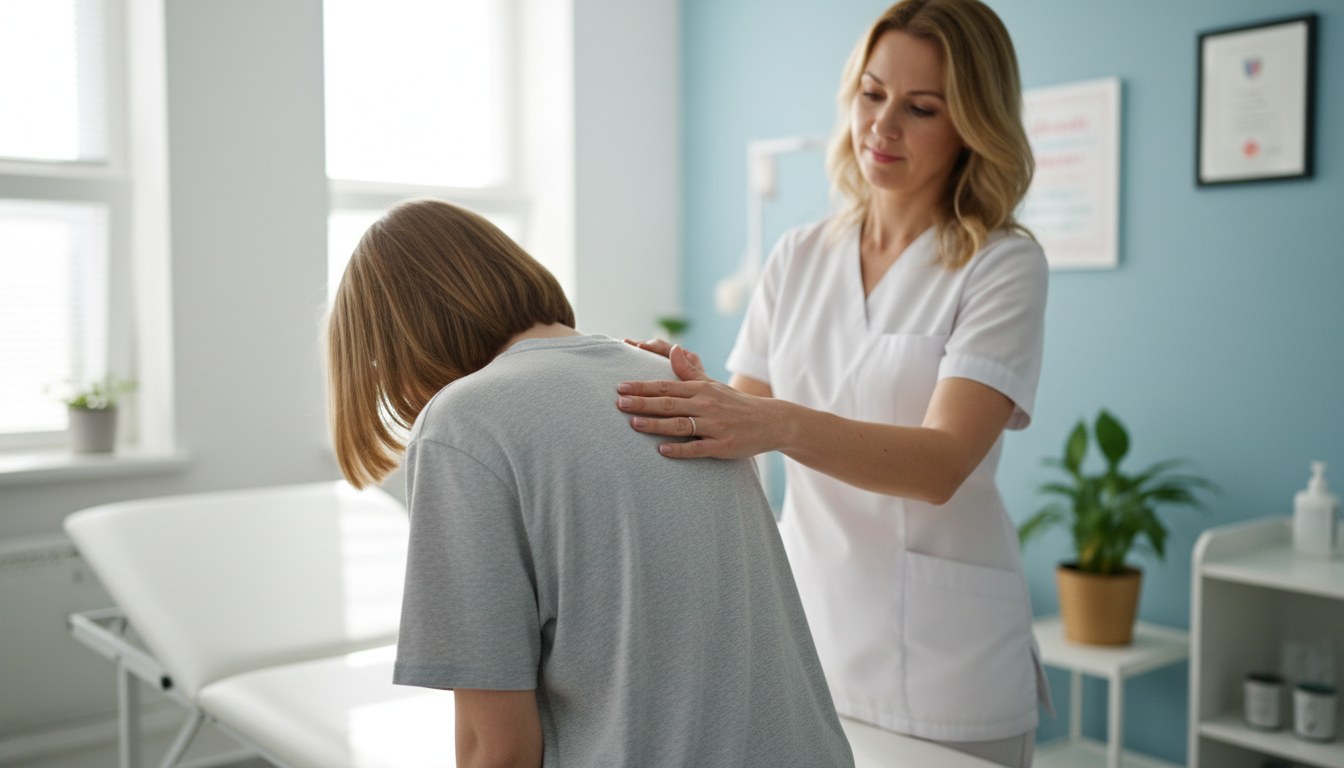
The usual first check is the forward bend test. The teen stands with feet together and bends at the waist with arms hanging down, while the examiner looks along the back from behind. A rib hump or a lower back bulge on one side can suggest the spine is rotating as well as curving. Many clinicians add a scoliometer, a small handheld tool that estimates trunk rotation.
School screening programs have used this approach for decades. A review of age- and sex-specific prevalence of scoliosis and the value of school screening programs looked at how often curves are found at different ages and in boys and girls, and at how useful screening is. Screening practices differ between regions, and a published guideline for adolescent scoliosis screening in China is one international example of how a health system can organize it. In the United States, school screening varies and professional groups differ on routine screening of teens without symptoms, so a parent who has a concern can raise it at a pediatric visit.
A positive screen is a reason for a closer look, not a diagnosis. Some teens with a positive screen turn out to have only mild asymmetry that needs no treatment.
How the curve is confirmed and measured
Clinicians combine the history, a physical examination, and imaging. A standing X-ray of the spine is the usual way to confirm scoliosis. The doctor measures the curve using the Cobb angle, which compares the tilt of the most tilted vertebrae at the top and bottom of the curve. A larger angle indicates a more pronounced curve. Orthopedic teams often use angle ranges as a rough guide, together with remaining growth, and can explain which range applies to your teen.
The X-ray also helps estimate how much growing the teen has left. This matters because curves are more likely to progress while a child is still growing. Clinicians often look at signs of skeletal maturity, the stage of puberty, and, for girls, whether periods have started. The location and pattern of the curve are noted too.
When an MRI or other tests may be added
Most teens with typical idiopathic scoliosis do not need further imaging. A clinician may consider an MRI or other evaluation when the picture looks different from the usual pattern. Examples include significant pain, pain that wakes a teen at night, abnormal findings on a neurologic exam, an unusually young age at onset, or a curve that progresses quickly. These features can sometimes be linked to a different underlying problem in the spine or nervous system, which is much less common than idiopathic scoliosis. One feature alone does not establish such a condition, and in many cases the evaluation is reassuring.
What may cause the curve
The cause of adolescent idiopathic scoliosis is not fully understood. Several factors are thought to contribute, and family history appears to play a role, since scoliosis often runs in families. Scoliosis can also develop because of other conditions, such as those affecting nerves and muscles. MedlinePlus lists, for example, spinal muscular atrophy among conditions that can involve spine curvature. A curve can also be present from birth. These forms are evaluated differently from the idiopathic type.
Backpacks, posture, sports, and sleeping position are commonly blamed, but they are not established causes of idiopathic scoliosis. Families can reasonably let go of guilt about habits.
Treatment: observation, bracing, and surgery
Treatment is based on the size of the curve, the teen's remaining growth, and how fast the curve is changing. In general, the options are observation, bracing, and surgery, and the right choice varies from teen to teen. The orthopedic team can explain how its own approach applies to your teen.
Observation for smaller curves
For a mild curve, the usual plan is regular checkups with repeat measurements. Many mild curves stay stable, though some can progress during growth. A teen who is nearly done growing is generally less likely to see a large change.
Bracing for growing teens with moderate curves
Orthopedic teams generally consider a brace when a growing teen has a moderate curve, or a smaller curve that is clearly progressing. The goal of bracing is to reduce the chance that the curve gets worse while the teen grows. It is not designed to straighten the spine permanently. Outcomes vary, and bracing works best when it is worn as the orthopedic team prescribes. Teens often find a brace hard to accept, so open conversation about comfort, clothing, sports, and school can help. Tell the clinician if the brace causes skin irritation, pain, or trouble breathing so they can adjust it.
Surgery for larger curves
Surgery is usually reserved for large or fast-progressing curves, or curves that continue to worsen despite bracing. The most common operation is spinal fusion, in which surgeons straighten part of the spine and join vertebrae so the correction holds. Surgeons discuss the benefits and risks, which include infection, bleeding, and a longer recovery. Whether and when to operate is a decision made with a pediatric spine specialist, based on the individual teen.
Exercise and physical therapy
Exercise is a common question. A systematic review with Bayesian network meta-analysis of exercise therapies in adolescent idiopathic scoliosis compared different approaches and suggests that some scoliosis-specific exercise programs may help reduce curve measurements in some teens. The quality of studies varies, and exercise is generally considered an addition to, not a replacement for, the plan from the orthopedic team. A physical therapist trained in scoliosis-specific methods can guide a program that fits the teen.
Regular sports and activity are generally encouraged. Ask the treating team whether any activity should be adjusted, especially while in a brace or after surgery.
Alternative approaches
Families sometimes ask about acupuncture, chiropractic care, or supplements. For acupuncture, a protocol for a systematic review exists, which describes how the evidence would be gathered, but a protocol is a plan and does not itself show that a treatment works. Before starting any alternative approach, tell the orthopedic clinician, so a curve that needs bracing or monitoring is not left unwatched.
Living with scoliosis as a teen
Scoliosis can affect more than the spine. A qualitative evidence synthesis on living with adolescent idiopathic scoliosis found themes such as concern about appearance, the burden of bracing, and the need for support from family and peers. Some teens feel self-conscious about their body or worry about being different. Listening without minimizing, and asking whether they would like to talk with a counselor or a peer support group, can help. A teen who seems persistently sad, withdrawn, or hopeless should be seen by a clinician. If a teen mentions thoughts of self-harm, call or text the 988 Suicide and Crisis Lifeline at 988, or call 911 if there is immediate danger.
Back pain and scoliosis
Many teens with idiopathic scoliosis have little or no back pain. When pain is present, it can have ordinary causes such as muscle strain. Pain that is severe, persistent, or that wakes a teen at night deserves prompt evaluation, since it can sometimes point to a cause other than idiopathic scoliosis. New or worsening numbness, tingling, or weakness in the legs, or a change in how your teen walks, needs a same-day medical evaluation. Go to the emergency room if these symptoms are worsening quickly or come with changes in bladder or bowel control. Both tiers are listed in the emergency section below.
What to ask at the visit
Helpful topics to bring up with the clinician include the size of the curve, how much growth remains, how often to repeat X-rays, and what signs would change the plan. Families can also ask how bracing would fit into school and sports, and whether physical therapy is appropriate. Keeping photos of the teen's back over time and noting when periods started or growth spurts happened can help the clinician judge how quickly things are changing.
Key takeaways
- Scoliosis in adolescents is often found on a forward bend exam and confirmed with a standing X-ray.
- Many curves are mild and are monitored. Some growing teens benefit from a brace, and surgery is considered for larger or progressing curves.
- Scoliosis-specific exercise may help some teens as part of a plan, and outcomes vary.
- New weakness, numbness, severe pain, or changes in bladder or bowel control need urgent evaluation.
When to Seek Medical Care
When to Seek Urgent or Emergency Care
Typical adolescent scoliosis is not an emergency, but new nerve or breathing problems in a teen with a curved spine need immediate care. This guidance is in addition to, not a replacement for, the general disclaimer above.
Emergency, call 911 or go to the emergency room immediately if:
- Sudden weakness, numbness, or inability to move one or both legs, especially with loss of bladder or bowel control.
- Leg weakness or numbness that is getting worse quickly, or any new loss of bladder or bowel control in a teen with scoliosis.
- Severe trouble breathing, bluish lips, or struggling to breathe after any injury or while wearing a brace.
- Severe back pain after a fall or crash, particularly with numbness, tingling, or inability to walk normally.
- Sudden chest pain with shortness of breath, or fainting, in a teen recovering from spine surgery.
- After spine surgery, fever with chills, a wound that opens or drains pus, or a swollen painful calf; go to the ER if the surgical team cannot be reached.
See a doctor soon (same-day or next available appointment) if:
- Back pain that wakes your teen at night or keeps getting worse needs prompt evaluation, so the clinician can decide whether more imaging is appropriate.
- New or worsening numbness, tingling, leg weakness, or a change in how your teen walks needs a same-day medical evaluation, even if it seems mild.
- A visible curve that appears to be getting larger quickly between visits, so the orthopedic team can reassess the plan.
- Fever, redness, drainage, or increasing pain near a surgical incision, which can be signs of infection; contact the surgical team the same day.
- Skin sores, severe pain, or breathing discomfort from a brace, so the team can adjust the fit.
Frequently Asked Questions
At what age does adolescent scoliosis usually appear?
Adolescent idiopathic scoliosis is usually noticed around the growth spurt before and during puberty. MedlinePlus describes scoliosis as most often appearing in this period. Because growth speeds can differ, the curve may become apparent at slightly different ages in different teens. A pediatrician can check the spine at routine visits.
Can a backpack or bad posture cause scoliosis?
Backpacks and slouching are commonly blamed, but they are not established causes of idiopathic scoliosis. The cause is not fully understood, and several factors, including family history, are thought to contribute. Posture can look uneven for ordinary reasons, so a clinician can tell the difference with an exam and, when needed, an X-ray.
Does the forward bend test hurt, and how accurate is it?
The forward bend test is painless. The teen bends at the waist while an examiner looks for a rib or back asymmetry. It is a screening step, so a positive result calls for a closer look rather than a diagnosis. Clinicians combine the exam with history and, when needed, a standing X-ray to confirm.
Will my teen definitely need a brace?
Not necessarily. Many mild curves are monitored with repeat checkups. A brace is generally considered for growing teens with moderate curves or curves that are clearly progressing. The decision depends on curve size, remaining growth, and how quickly the curve changes, so the orthopedic team individualizes the plan for each teen.
Is surgery common for adolescent scoliosis?
Surgery is usually reserved for larger or fast-progressing curves, or ones that keep worsening despite bracing. Many teens never need it. When surgery is discussed, a pediatric spine specialist reviews the expected benefits, the risks, such as infection and bleeding, and the recovery. Families can ask for time to consider options.
Can exercise or physical therapy fix a curved spine?
Exercise cannot be promised to straighten a curve. A systematic review of exercise therapies suggests scoliosis-specific programs may help reduce curve measures in some teens, but study quality varies. Exercise is generally viewed as a complement to the plan from the orthopedic team. A therapist trained in scoliosis methods can tailor a program.
Is back pain normal with scoliosis?
Many teens with idiopathic scoliosis have little or no pain. When pain occurs, it can have ordinary causes like muscle strain. Pain that is severe, persistent, or wakes a teen at night warrants evaluation, since it can sometimes point to another cause. Tell the clinician about any leg numbness or weakness.
Can my teen still play sports with scoliosis?
Many teens with scoliosis stay active, and regular activity is generally encouraged. Ask the treating team whether any adjustments are needed, especially while in a brace or after surgery. Tell them about pain with activity, as that may need evaluation.
Related articles
Early Signs of Osteoporosis Before a Fracture HappensEarly Signs of Autism in Toddlers: What Do Pediatricians Look For?Osteoarthritis: Causes, Symptoms, and ManagementSources
- MedlinePlus (NIH) - Scoliosis
- MedlinePlus (NIH) - Spinal Muscular Atrophy
- PubMed Central (NIH) - Guideline for adolescent scoliosis screening in China (public version 2024)
- PubMed Central (NIH) - Age- and sex-specific prevalence of scoliosis and the value of school screening programs
- PubMed Central (NIH) - Evaluating exercise therapies in adolescent idiopathic scoliosis: a systematic review with Bayesian network meta-analysis
- PubMed Central (NIH) - The experience of living with adolescent idiopathic scoliosis: a qualitative evidence synthesis using meta-ethnography
- PubMed Central (NIH) - The effectiveness and safety of acupuncture for scoliosis: A protocol for systematic review and/or meta-analysis