Why Do My Feet and Ankles Swell So Much in the Third Trimester?
Feet and ankle swelling in the third trimester is common and often normal. Your body holds more blood and fluid by late pregnancy, and your growing uterus presses on the veins that return blood from your legs, so fluid can pool in your lower body by evening.
Pregnancy & Women's HealthPregnancy Swellingsymptom-check
Written By: DocAi Health Editorial Team
Last Updated: 2026-09-30
Last Updated: 2026-09-30
Medical Disclaimer: This article is for general informational and educational purposes only and is not medical advice. It does not create a doctor-patient relationship and is not a substitute for professional diagnosis or treatment by a qualified healthcare provider. Never disregard or delay seeking professional medical advice because of something you have read here. If you think you may have a medical emergency, call 911 or your local emergency number right away. Health information can change and this guidance is general and US-focused, so consult a licensed clinician in your own country about your specific situation.
Feet and ankle swelling in the third trimester is common and often normal. Your body holds more blood and fluid by late pregnancy, and your growing uterus presses on the veins that return blood from your legs, so fluid can pool in your lower body by evening. This kind of swelling, called edema, often eases overnight and may improve with rest, elevation, and compression. It needs urgent attention when it comes on suddenly, involves your face or hands, affects only one leg, or comes with a headache that will not go away, vision changes, or pain under your ribs.
Why Your Legs Swell More Late in Pregnancy
Several factors contribute to swelling in the third trimester. Your body makes more blood during pregnancy to support your baby's growth, as ACOG notes, so by the third trimester you are carrying more blood and fluid than usual. That extra fluid has to go somewhere, and gravity pulls much of it down into your feet and ankles over the course of the day. Your growing uterus can also press on the large vein that carries blood from your legs back up toward your heart, which can slow the return flow so blood and fluid pool below your knees, especially after hours of standing, walking, or sitting with your feet down. Hormone changes and shifts in how fluid moves between your blood vessels and the surrounding tissue may play a part too. MedlinePlus (NIH) notes that some swelling is common during pregnancy and that long car rides or flights and standing for long periods often lead to swelling in the feet and ankles. Heat can also make ordinary swelling more noticeable.
What Normal Swelling Looks Like
Typical third-trimester edema often builds gradually over the course of a day rather than appearing all at once. Ankles often look closer to normal in the morning and puffier as the day goes on, especially after an active day. Ordinary swelling often affects both legs about equally, and pain, warmth, or redness in one area is a reason to call. Elevating your legs or a night's sleep may bring the swelling down at least partway, and it may return the next day following the same pattern. Mayo Clinic describes mild foot and ankle swelling during pregnancy as not a cause for worry. MedlinePlus (NIH) advises contacting your provider right away if you are pregnant and have more than mild swelling or a sudden increase in swelling, if a swollen foot or leg is red or warm to the touch, or if swelling comes with a fever. Swelling that keeps getting worse despite rest and leg elevation is also worth a call to your provider. New puffiness in your hands or face is different: ACOG lists swelling of the face or hands among the possible symptoms of preeclampsia, so call your ob-gyn right away. If your swelling matches the ordinary pattern, your prenatal care team may note it as an expected part of late pregnancy and continue to monitor it at your regular visits rather than treat it as a problem on its own.
When Swelling May Signal Preeclampsia
A different pattern of swelling can be an early sign of preeclampsia, a serious pregnancy disorder involving high blood pressure that can affect organs throughout your body, including your kidneys and liver. It is much less common than ordinary swelling: NICHD (NIH) notes that some estimates put it at about 3.4% of pregnancies in the United States, although the exact number is not known. ACOG lists swelling of the face or hands, a headache that will not go away, seeing spots or changes in eyesight, pain in the upper abdomen or shoulder, nausea and vomiting in the second half of pregnancy, sudden weight gain, and difficulty breathing among the possible symptoms, and advises calling your ob-gyn right away if you have any of them, especially in the second half of pregnancy. Swelling that raises concern can show up suddenly rather than building slowly, and it may appear in places gravity would not explain, such as your face, around your eyes, or your hands, in addition to your feet.
On its own, swelling is not enough to diagnose preeclampsia, but swelling together with a headache that will not ease, changes in vision such as blurry vision, flashing lights, spots, or temporary vision loss, or pain under your ribs on the right side is a pattern that raises concern. Any one of those warning signs is a reason to call even without swelling, and a milder headache that comes and goes alongside new swelling is also worth a call. ACOG defines high blood pressure in pregnancy as 140 systolic or 90 diastolic or higher, and severe high blood pressure as 160 systolic or 110 diastolic or higher; a high reading may be checked again to confirm it. A reading in the severe range needs immediate medical assessment, even if you feel well, and a home reading of 140/90 or higher without other symptoms is still a reason to contact your provider.
Your prenatal team routinely checks your blood pressure and may check your urine or order other tests when there are concerns about preeclampsia. A normal reading at home does not rule out a pregnancy complication such as preeclampsia; ACOG notes that blood pressure changes often during the day. New symptoms such as a severe headache, vision changes, or pain in the upper abdomen should be assessed right away even if a home reading is not high.
Preeclampsia can also develop after delivery. CDC and ACOG both note that it can happen in the weeks after childbirth, so new swelling of the face or hands after birth, or swelling that comes with a severe headache, vision changes, upper abdominal pain, shortness of breath, or high blood pressure, needs medical evaluation right away. CDC advises telling your doctor or calling 9-1-1 right away for preeclampsia symptoms after delivery. When preeclampsia leads to seizures the condition is called eclampsia, which CDC describes as a medical emergency, so a seizure is a reason to call 911. For a full rundown of what to watch for, see our guide to the warning signs of preeclampsia, and for help telling ordinary headaches from warning signs, see headaches during pregnancy.
Swelling in Only One Leg
Swelling that shows up in one leg but not the other is a different kind of red flag. Pregnancy raises the chance of blood clots: NHLBI (NIH) says the likelihood is higher than usual during pregnancy and in the first 6 weeks after giving birth, and that bed rest during pregnancy can lower blood flow through your veins. A clot in a deep leg vein, called a deep vein thrombosis or DVT, can cause swelling in just one calf or leg, along with pain, tenderness, warmth, or redness in that area. It can feel like a pulled muscle at first, which is part of what makes it easy to dismiss. Your chance is also higher after recent surgery or if you have a personal or family history of blood clots. For more on the early signs, see early signs of a blood clot in the leg.
The reason one-sided swelling matters urgently is that part of a clot can break loose and travel to your lungs, causing a pulmonary embolism (PE), a medical emergency. NHLBI advises calling your healthcare provider right away if you think you may have symptoms of a blood clot, because a DVT may lead to a life-threatening PE. New one-sided leg swelling, especially with pain, warmth, redness, or tenderness, needs urgent medical assessment. If you also develop new or worsening shortness of breath, chest pain, coughing up blood, or fainting, call 911 or seek emergency care immediately.
What Actually Helps
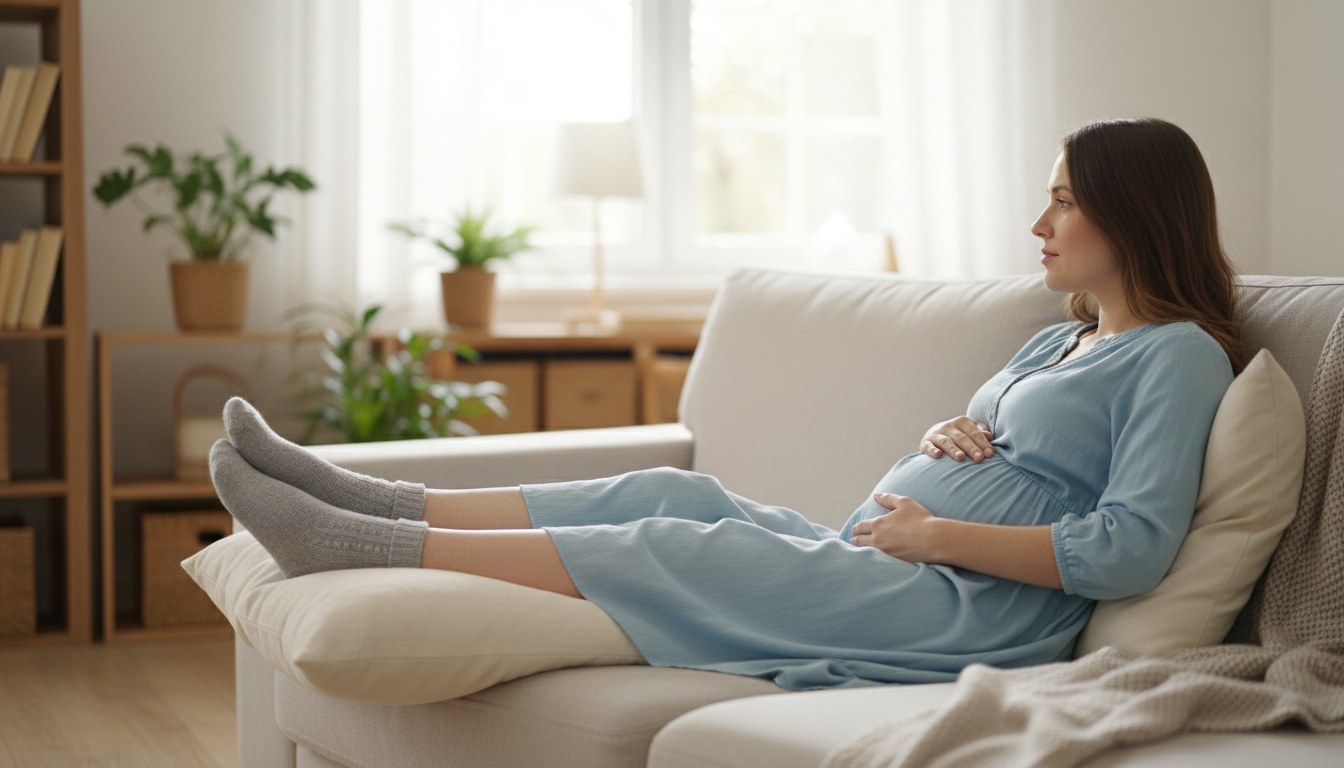
For ordinary, both-legs, end-of-day swelling, a few consistent habits may help. MedlinePlus (NIH) suggests putting your legs on pillows to raise them above your heart while lying down. Resting with your feet raised whenever you can, especially after long periods of standing or sitting, is a good place to start. Resting on your side, particularly your left side, can reduce pressure from the uterus on the major blood vessels that return blood from your legs, and Mayo Clinic suggests sleeping on your left side for this reason. Change position often instead of standing or sitting still for long stretches, and take short walks to keep blood moving; see exercise in the third trimester for what is generally safe.
Graduated compression stockings may help reduce leg and ankle swelling, and many people put them on first thing in the morning, before swelling builds. If you have significant swelling, pain, or a history of blood clots, ask your clinician before using compression garments. Keep drinking normally throughout the day: Mayo Clinic notes that having ankle swelling does not mean you should cut back on how much you drink. Restricting fluids is not a recommended way to treat normal pregnancy swelling. Ask your prenatal provider whether cutting back on salty foods is right for you, since your body still needs some sodium during pregnancy. These steps may ease normal third-trimester swelling, but they may not make it disappear completely.
What Your Prenatal Visits Are Checking For
ACOG says your ob-gyn should check your blood pressure at each prenatal visit, and because preeclampsia can develop quietly, a high reading may be followed by a urine test for protein and other tests. Providers also commonly ask about swelling. These checks are designed to catch the pattern early, sometimes before you notice anything beyond the swelling itself. Mention any new swelling at your next appointment even if it does not fit the emergency picture below, call sooner if it keeps getting worse, and describe exactly how and where it started, since that detail helps your provider tell ordinary edema apart from something that needs a closer look right away.
When to Seek Medical Care
When to Seek Urgent or Emergency Care
Swelling in the feet and ankles is common in the third trimester. The patterns below are reasons to get checked instead of waiting for your next scheduled visit. Some need 911, and for others you should call your maternity care team right away or go to the emergency room; each line in the first list says which. This guidance is in addition to, not a replacement for, the general disclaimer above.
Emergency, call 911 or go to the emergency room immediately if:
- New or worsening shortness of breath or trouble breathing, chest pain, coughing up blood, or fainting, especially with leg swelling (call 911; can signal a blood clot in the lung)
- A seizure (call 911; can signal eclampsia, a serious complication of preeclampsia)
- A blood pressure reading of 160 systolic or 110 diastolic or higher, even if you feel well (a severe-range reading that needs immediate medical assessment, so go to the emergency room or call your care team right away; call 911 if you also have severe symptoms or feel very unwell)
- Swelling in only one leg, a swollen leg or foot that is red, warm, or painful to the touch, or swelling with a fever (needs urgent medical assessment for a blood clot or infection; go to the emergency room or call your care team right away)
- New or sudden swelling in your face or hands, especially around your eyes, or sudden weight gain (call your maternity care team right away or go to the emergency room; can be signs of preeclampsia)
- Swelling in your feet, ankles, or legs that increases suddenly instead of building up gradually during the day, or that is more than the ordinary end-of-day puffiness (call your maternity care team right away)
- A severe or persistent headache that does not go away, especially with vision changes, upper abdominal pain, or other symptoms of preeclampsia (call your maternity care team right away or go to the emergency room)
- Vision changes such as blurry vision, flashing lights, spots, or temporary vision loss (call your maternity care team right away or go to the emergency room)
- Pain in your upper abdomen, especially the upper right side or below your ribs, pain in your shoulder, or new nausea and vomiting in the second half of pregnancy (call your maternity care team right away or go to the emergency room)
- After delivery: new swelling of your face or hands, or swelling with a severe headache, vision changes, upper abdominal pain, or high blood pressure (call your care team right away or go to the emergency room; call 911 for trouble breathing, chest pain, or a seizure)
See a doctor soon (same-day or next available appointment) if:
- Swelling that does not improve with self-care such as rest and leg elevation (call your provider today)
- Swelling that keeps getting worse (call your provider today, or right away if you have heart, kidney, or liver disease)
- New swelling along with a headache, even one that comes and goes, and even without any of the emergency signs above
- A home blood pressure reading of 140 systolic or 90 diastolic or higher, without any of the emergency signs above (the level ACOG uses to define high blood pressure in pregnancy)
Frequently Asked Questions
Is it normal for my feet to be too swollen for my shoes in the third trimester?
Needing wider shoes or sandals is common in the third trimester as fluid builds up in your feet over the course of pregnancy. Many people size up temporarily or switch to open, adjustable footwear. If the swelling in your shoes is roughly the same on both feet and eases overnight, it fits the usual pattern; still mention it at your next visit, and call your provider right away if it is more than mild for you or increases suddenly.
Why is only one of my legs more swollen than the other?
Mild differences between your legs can happen, but swelling that is clearly worse in one leg, especially with pain, tenderness, warmth, or redness, can be a sign of a blood clot in that leg. Because a clot can travel to the lungs, this pattern needs urgent medical assessment rather than being watched at home. If you also have new or worsening shortness of breath, chest pain, coughing up blood, or fainting, call 911.
Does drinking more water help pregnancy swelling or make it worse?
Swelling is not a reason to cut back on fluids, and restricting fluids is not a recommended way to treat normal pregnancy swelling. Mayo Clinic notes that ankle swelling does not mean you should cut back on how much you drink. Aim for steady fluid intake throughout the day, and talk to your provider if you are unsure how much is right for you given your weight and activity level.
Can compression socks help with third-trimester swelling?
Graduated compression stockings may help reduce leg and ankle swelling by supporting blood flow back up your legs. Many people put them on first thing in the morning, before swelling builds for the day. If you have significant swelling, pain, or a history of blood clots, ask your clinician before using compression garments.
How much swelling is too much during pregnancy?
There is no single number that separates normal from concerning swelling. What matters more is the pattern: sudden onset, swelling in your face or hands, one leg swelling much more than the other, or swelling paired with a headache that will not go away, vision changes, or upper abdominal pain. Any of those patterns is a reason to call your provider right away; ACOG lists facial or hand swelling, a headache that will not go away, and changes in eyesight among the symptoms of preeclampsia.
Does swelling in pregnancy always mean preeclampsia?
No. Swelling in the feet and ankles is common in late pregnancy and is often normal, while preeclampsia is much less common. Preeclampsia is more concerning when swelling is sudden or occurs with other warning signs such as severe headache, vision changes, upper abdominal pain, or high blood pressure. Your prenatal visits include blood pressure checks so that changes can be picked up even before you notice symptoms, since preeclampsia can develop quietly.
When does swelling from pregnancy go away after delivery?
Pregnancy-related swelling usually improves gradually after delivery as your body gets rid of the extra fluid, and some swelling can persist for days or longer. Preeclampsia can also develop after delivery, so new swelling of the face or hands after birth, or swelling that comes with a severe headache, vision changes, upper abdominal pain, shortness of breath, or high blood pressure, needs medical evaluation right away, and CDC advises telling your doctor or calling 9-1-1 right away for preeclampsia symptoms after delivery.
Related articles
Signs of Preeclampsia Every Pregnant Person Should KnowExercise in the Third Trimester: Is It Safe?Headaches During Pregnancy: What's Normal and How to Find ReliefSources
- MedlinePlus (NIH) - Foot, leg, and ankle swelling
- ACOG - Preeclampsia and High Blood Pressure During Pregnancy
- Mayo Clinic - Ankle swelling during pregnancy: What helps?
- CDC - High Blood Pressure During Pregnancy
- NICHD (NIH) - Preeclampsia and Eclampsia
- NHLBI (NIH) - Venous Thromboembolism Symptoms
- NHLBI (NIH) - Women and venous thromboembolism (VTE)
- ACOG Practice Bulletin No. 222 - Gestational Hypertension and Preeclampsia